Special offer. Ariosti: 6 Lessons For Viola d'Amore & Continuo
Mauro Righini (viola d'amore), Elena Bertuzzi (soprano), Ugo Nastrucci (theorbo), Danilo Costantini (organ/harpsichord)
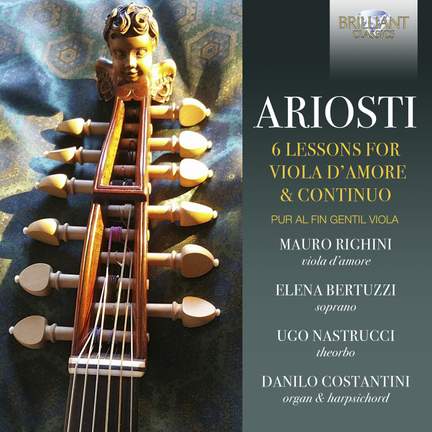
Special offer. Ariosti: 6 Lessons For Viola d'Amore & Continuo
Mauro Righini (viola d'amore), Elena Bertuzzi (soprano), Ugo Nastrucci (theorbo), Danilo Costantini (organ/harpsichord)
Purchase product
About
The violinist, organist, composer and librettist Attilio Malachia Ariosti was born in Bologna in 1666. His career took him to Mantua and Venice, the most enlightened musical and artistic centres of northern Italy at the time, then to Berlin and finally Vienna in 1703. Expelled from the Papal State for moral reasons, by 1716 he was living in London where, together with Bononcini and Handel, he became a permanent composer of the Royal Academy.
His Six Lessons for Viola d’Amore, published in London in 1724 and dedicated to King George, were as the name implies composed expressly to teach violinists to play the viola d’amore. They are written in scordatura with a system of movable keys to indicate the different positions and fingerings of the left hand up to the fourth position.
Ariosti’s Cantata for solo voice with the viola d’amore Pur al fin gentil Viola was probably composed around 1690.
The viola d’amore has six or seven strings and (almost always) the same number of resonance strings placed under the bridge, which strongly characterise its timbre. Tunings were variable and, although from the second half of the 18th century the tuning in D became standard, it is not always straightforward to know which to use. For this reason, viola d’amore parts are written in scordatura, a sort of tablature in which the written note indicates the finger position according to standard tuning, but not the sounding pitch on a ‘detuned’ string. This fascinating and somewhat mysterious instrument is played by both violinists and violists; for violists in particular it offers access to a new, though unfortunately not very vast, repertoire, with works by Biber, Bach, Ariosti and Vivaldi, and more recently Hindemith, Martin, Ghedini and many others.
Contents and tracklist
- Mauro Righini, Elena Bertuzzi, Ugo Nastrucci, Danilo Costantini
- Mauro Righini, Elena Bertuzzi, Ugo Nastrucci, Danilo Costantini
- Mauro Righini, Elena Bertuzzi, Ugo Nastrucci, Danilo Costantini
- Mauro Righini, Ugo Nastrucci, Danilo Costantini
- Mauro Righini, Ugo Nastrucci, Danilo Costantini
- Mauro Righini, Ugo Nastrucci, Danilo Costantini
- Mauro Righini, Elena Bertuzzi, Ugo Nastrucci, Danilo Costantini