Korngold: String Quartet Nos. 2, Op. 26 & No. 3, Op. 34
Alma Quartet
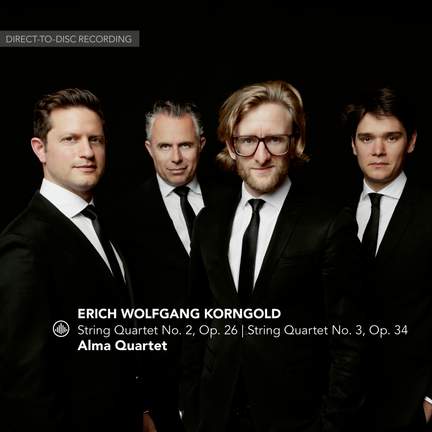
This is a so-called ‘direct to disc’ recording: the pieces are played straight through in a studio, unedited, to simulate the freshness and adrenaline-rush of a live concert. While there are...
Korngold: String Quartet Nos. 2, Op. 26 & No. 3, Op. 34
Alma Quartet
Purchase product
Other available formats

This is a so-called ‘direct to disc’ recording: the pieces are played straight through in a studio, unedited, to simulate the freshness and adrenaline-rush of a live concert. While there are...
About
The first volume of the Alma Quartet's complete survey of Korngold's string quartets.
Erich Wolfgang Korngold (1897-1957) was a genius. Naturally he was most widely known and rewarded as one of the founding composers of Hollywood film music, but he is not a particularly well-known composer in the classical music world. His three string quartets are surely masterpieces and can be seen as modern tone poems imbued with beautiful melancholy and Viennese charm. A child prodigy, Korngold wrote some of the most heart-wrenching melodies, which are sure to leave any listener longing for more.
His String Quartet No. 2, Op. 26 (1933) was written just before Korngold moved to Hollywood and is full of musical imagery of Vienna, with gestures towards the waltzes of Johan Strauss II as well as the intricate lyricism of Richard Strauss. A fierce anti-serialist, Korngold was determined that it was still possible to stretch the boundaries of tonality without adapting to the 12-tone technique.
The String Quartet No. 3, Op. 34 (1945) is full of themes that he used in his film scores and was written when Korngold was suffering from deep depression. The quartet is much darker.
Why did we choose to tackle Korngold's music for this unique project of a direct-to-disc recording on vinyl? The music resonates deeply with us, as it represents the epitome of late romanticism and lyrical expression. We all have a profound love for romantic music and after listening to some recordings of his quartets we knew instantly these were the perfect fit for us. It was definitely a challenge to understand the idiom in Korngold's writing. Our individual personalities as well as the Alma sound is clearly audible.
What makes a direct-to-disc recording so special? Without doubt, it is the most honest way of recording. What you hear is what you get, with no editing whatsoever. It is thus a studio recording with all of the nuances and thrill of a live performance. Evidently, the process is extremely strenuous and challenging. You want to make sure that the performance is as perfect as can be, but you also have to take into account the fact that perfection is simply not feasible. But the question is whether or not perfection is truly exciting and honest. Korngold's music was by now deeply embedded in our DNA and we knew how to tell the story!
Contents and tracklist
- Alma Quartet
- Alma Quartet
Awards and reviews
 February 2022
This is a so-called ‘direct to disc’ recording: the pieces are played straight through in a studio, unedited, to simulate the freshness and adrenaline-rush of a live concert. While there are small technical glitches here and there, it largely succeeds; so, too, does the group’s ‘storytelling’ approach to the works in hand.