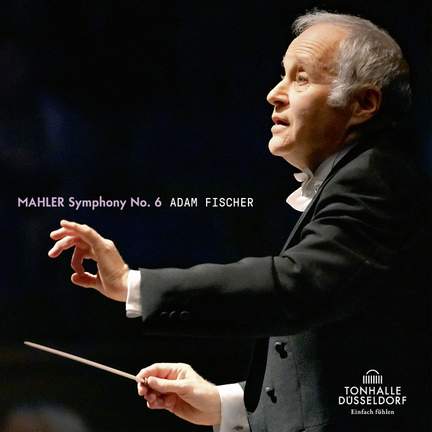
Special offer. Mahler: Symphony No. 6
Dusseldorfer Symphoniker, Adam Fischer
Awards:
-
BBC Music Magazine, January 2022, Orchestral Choice

Every aspect of this colossal symphony finds its proper expression in the latest instalment of Ádám Fischer’s hugely impressive Dusseldorf Mahler cycle – which is not to say it’s in any way...
Special offer. Mahler: Symphony No. 6
Dusseldorfer Symphoniker, Adam Fischer
Purchase product
Awards:
-
BBC Music Magazine, January 2022, Orchestral Choice
Every aspect of this colossal symphony finds its proper expression in the latest instalment of Ádám Fischer’s hugely impressive Dusseldorf Mahler cycle – which is not to say it’s in any way...
About
The series of the Mahler Symphonies with the Dusseldorf Symphonic under the baton of Adam Fischer has come to this end with the release of the Symphony No. 6.
Over the last four years Adam Fischer's Mahler recordings grew to a most successful recording project, winning the BBC Music Magazine Award, and the OPUS KLASSIK Trophy in Germany and many splendid and outstanding reviews from around the world.
In the Dusseldorf Tonhalle in late February and early March 2020, we gave Mahler's Sixth Symphony in three live concert performances which we recorded for this CD. This date in the calendar had special significance: the first lockdown period due to the Corona pandemic set in immediately thereafter.
The orchestra was playing in full line-up in front of a full house for the last time for a long while. The mood was ominous: we all felt something was amiss, and the next day everything had to be cancelled. We strongly associate those circumstances with our work on the Sixth, and with the foreboding we felt of a catastrophe that has since ruined the livelihoods of many musician colleagues and deprived us all of a meaningful period in our lives. Mahler's Sixth is always a major event for the orchestra and for the audience. One leaves the concert hall weary and exhausted; time is required to regain one's composure. This symphony requires a gigantic orchestra: here, once more, Mahler was attempting to stretch the boundaries of what was possible in his day.
Not to achieve a mere effect, but simply because he needed such a gigantic instrumental apparatus to express his feelings. The sheer amount of emotions we deal with in this symphony is almost unbearable. The controversial third hammer blow provides a good example: Mahler most certainly crossed it out after a rehearsal, overcome by emotion, afraid of dying. In his very bones he thought and felt that this symphony would prompt his demise
In my view, some of this symphony's most beautiful, yet also most difficult moments are found in the Scherzo. Mahler wrote the instruction altvaterlich (old-fashioned). I have given much thought to what he might have meant by that. Here we have a great number of slight rubatos that are not easy to carry out in practice. If you are too afraid of losing control and you play these passages too mechanically, the music loses its character. On the other hand, it should not sound unstable, as if you were weak in the knees. These passages require precise chamber-music-making among the orchestra groups. In the immediate wake of massive tuttis, this becomes a delicate matter. If you succeed in getting it right if the oboes, the bassoon, and the violins manage to play those rubatos together and breathe together the result can be fantastic. (from Adam Fischer's remarks of the booklet texts)
Contents and tracklist
Awards and reviews
-
BBC Music MagazineJanuary 2022Orchestral Choice
 January 2022
Every aspect of this colossal symphony finds its proper expression in the latest instalment of Ádám Fischer’s hugely impressive Dusseldorf Mahler cycle – which is not to say it’s in any way a middle-of-the-road performance...The engineering is superlative.
 February 2022
Fischer is poignant and plainspeaking throughout, with plangent wind solos.