Monteverdi and Friends
Vespro da Camera
Marie Luise Werneburg (soprano), Alexander Schneider (alto), Johannes Gaubitz (tenor), Dominik Worner (bass), Musica Ficta, Roland Wilson
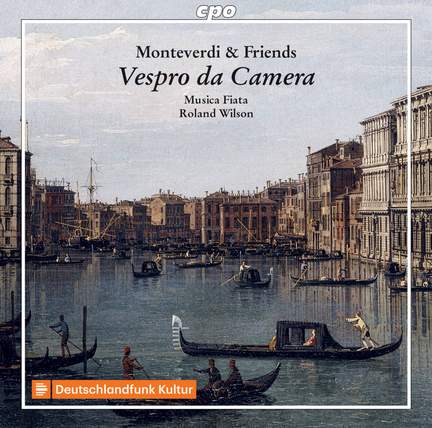
Musica Fiata’s four voices and five players assemble to conjure flexible colours and a range of sonorities from solo intimacy to enticingly fulsome textures in Rovetta’s Dixit Dominus and six-part...
Monteverdi and Friends
Vespro da Camera
Marie Luise Werneburg (soprano), Alexander Schneider (alto), Johannes Gaubitz (tenor), Dominik Worner (bass), Musica Ficta, Roland Wilson
Purchase product
Musica Fiata’s four voices and five players assemble to conjure flexible colours and a range of sonorities from solo intimacy to enticingly fulsome textures in Rovetta’s Dixit Dominus and six-part...
About
There can be no doubt that Claudio Monteverdi was a great composer and that he wrote many a magnificent work for St. Mark’s Cathedral. Yet, after many long years, we are now gradually coming to the realization that the Venetian musical universe was not limited to San Marco. Without wanting to diminish Monteverdi’s genius, we have to admit that this master was a member of a gifted, innovative circle of composers whose creative production was also beneficial to him. On the present new release we hear sacred works, including rare Psalm settings, not only by Monteverdi himself but also by Giovanni Rovetta, Antonio Rigatti, and Dario Costello. The musical language employed by Monteverdi in his later sacred works displays a theatrical character, rich affections, and a predilection for strong contrasts that can hardly be distinguished from the style of his late madrigals and operas. His substitute Giovanni Rovetta and his pupil Giovanni Antonio Rigatti used the very same language. They more clearly combine the instruments with the singers, at times have them imitate the song lines, and in other places fill out the textures of the tutti segments with them. With their four vocal parts, two high instruments, and the plenum sound of the organ, the homophonic passages create the illusion of a much larger ensemble. Might it be possible that Monteverdi was influenced by his younger colleagues, just as they were influenced by him?
Contents and tracklist
Awards and reviews
 January 2022
Musica Fiata’s four voices and five players assemble to conjure flexible colours and a range of sonorities from solo intimacy to enticingly fulsome textures in Rovetta’s Dixit Dominus and six-part Magnificat...an imaginative programme that casts light on Monteverdi’s colleagues.