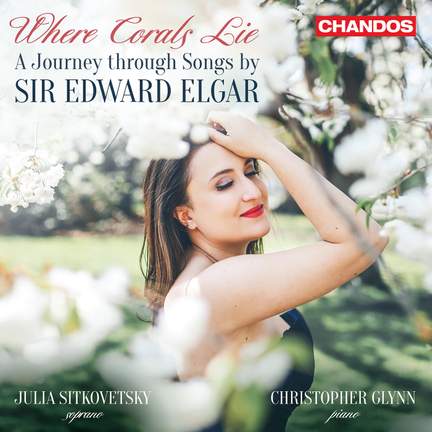
Elgar: Where Corals Lie
A Journey through Songs by Edward Elgar
Julia Sitkovetsky (soprano), Christopher Glynn (piano)
She displays a vivid response to the text of Elgar’s cycle, which gives the album its title, and a quite different sound from the usual contralto or mezzo, while Glynn evokes Elgar’s orchestral...
Elgar: Where Corals Lie
A Journey through Songs by Edward Elgar
Julia Sitkovetsky (soprano), Christopher Glynn (piano)
Purchase product
She displays a vivid response to the text of Elgar’s cycle, which gives the album its title, and a quite different sound from the usual contralto or mezzo, while Glynn evokes Elgar’s orchestral...
About
Working in an era before Arts Council grants, public sponso rship, recording royalties, and long-term publishing deals, Elgar had to write for the public demand as much as personal satisfaction. The effort required for his large-scale works was rarely reflected in profitable income, so writing songs could be a useful way to earn money. The England of Elgar’s time favoured popular ballads, sung by well-known singers. These were then sold as sheet music, the singer’s name emblazoned on the cover, for performances given in middle-class homes. There was little demand for lengthy song cycles, or song recitals consisting entirely of ‘serious’ repertoire in the German tradition. As a result, Elgar’s songs are often individual works, sometimes adapting instrumental works into songs (such as ‘Land of Hope and Glory’) when the commercial opportunities arose. Elgar also chose poetry that was popular and straightforward, rather than drawing on the established classical masterpieces. These songs were then transposed into numerous keys to allow performance by any voice type, designed for mass appeal and profitable sales.
Contents and tracklist
Spotlight on this release
-
An error occurred.
Try watching this video on www.youtube.com, or enable JavaScript if it is disabled in your browser.
Awards and reviews
 3rd October 2021
She displays a vivid response to the text of Elgar’s cycle, which gives the album its title, and a quite different sound from the usual contralto or mezzo, while Glynn evokes Elgar’s orchestral colours with his playing.