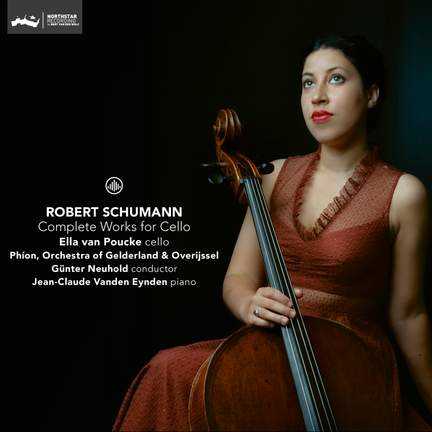
Schumann: Complete Works for Cello
Ella van Poucke, Jean-Claude Vanden Eynden (piano), Phion, Orchestra of Gelderland & Overijssel, Günter Neuhold
In the Concerto, van Poucke’s performance is distinguished by its spontaneity and delicacy, her playing of the double-stopped passages in the slow movement especially affecting.
Schumann: Complete Works for Cello
Ella van Poucke, Jean-Claude Vanden Eynden (piano), Phion, Orchestra of Gelderland & Overijssel, Günter Neuhold
Purchase product
In the Concerto, van Poucke’s performance is distinguished by its spontaneity and delicacy, her playing of the double-stopped passages in the slow movement especially affecting.
About
Schumann's complete works for cello played by Ella van Poucke, the winner of the prestigious Premio Chigiana in 2017 and most recently the Grachtenfestival Prize.
Schumann composed his Cello Concerto in about two weeks during November 1850. Before Schumann, few major composers had written cello concertos. Schumann avoids technical display for its own sake, allowing his characteristic poetic expression, intimacy and fantasy to prevail.
Schumann originally scored the Fantasiestucke Opus 73 (1849) for clarinet and piano but simultaneously provided alternative arrangements for violin or cello. In his choice of clarinet Schumann was typically innovative. The three pieces are melodically interrelated, creating a unity underlined by the absence of breaks between them.
Schumann's Adagio and Allegro in A flat major, Opus 70 dates from a week after the Fantasiestucke Opus 73. He originally intended his Opus 70 for the new valve horn, though he named cello, violin or viola as alternative instruments. The piece is fully characteristic of Schumann's Romantic spirit. The expansive and dreamily romantic Adagio gives way to an Allegro with a leaping, joyful main theme.
Just as Schumann had wanted "popular elements" to prevail in his Rhenish Symphony (1850), the Fnf stcke im Volkston (1849) are correspondingly simple, tuneful and accessible. Nevertheless Schumann's creative imagination and wide expressive range are no less apparent.
Ella van Poucke is the first prize winner of the International Isang Yun cello competition 2015, the Leopoldinum Award 2015, Prix Nicolas Firmenich 2013, Elisabeth Everts Award 2014, Prix Academie Maurice Ravel 2012, Dutch Musician of the Year 2012, first prize winner of the 2008 Princess Christina Competition and recipient of the special prize in "recognition of an outstanding performance at the Grand Prix Emanuel Feuermann 2014.
The Phion orchestra was created in 2019 after two of the longest established Dutch orchestras merged: the Gelders Orkest (established 1889) and the Orkest van het Oosten (established 1933).
Contents and tracklist
- Ella van Poucke, Jean-Claude Vanden Eynden
- Ella van Poucke, Jean-Claude Vanden Eynden
- Ella van Poucke, Jean-Claude Vanden Eynden
- Ella van Poucke
- Phion, Orchestra of Gelderland & Overijssel
- Günter Neuhold
Awards and reviews
 November 2021
In the Concerto, van Poucke’s performance is distinguished by its spontaneity and delicacy, her playing of the double-stopped passages in the slow movement especially affecting.