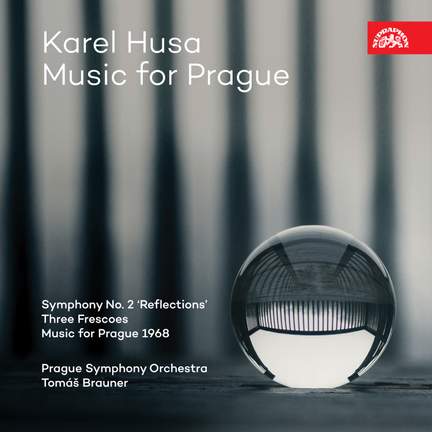
Special offer. Karel Husa: Music For Prague
Prague Symphony Orchestra, Tomáš Brauner
Awards:
-
International Classical Music Awards, 2022, Nominated - Symphonic Music

Tomás Brauner and the Prague Symphony Orchestra on this well-recorded disc capture Husa’s attenuated orchestral textures with passion and insight; only the finale of Music for Prague 1968 seems...
Special offer. Karel Husa: Music For Prague
Prague Symphony Orchestra, Tomáš Brauner
Purchase product
Awards:
-
International Classical Music Awards, 2022, Nominated - Symphonic Music
Tomás Brauner and the Prague Symphony Orchestra on this well-recorded disc capture Husa’s attenuated orchestral textures with passion and insight; only the finale of Music for Prague 1968 seems...
About
Karel Husa – a Czech-born composer whose name resonates more on an international scale than in his native country. The winner of the Pulitzer Prize and the Grawemeyer Award (other recipients include Boulez, Adés, Dun and Ligeti), he was commissioned to write music for the New York Philharmonic, and other distinguished orchestras and artists.
The centenary of Karel Husa’s birth is a unique opportunity to recall his remarkable fate and oeuvre.
During World War II, he lived in Nazi-occupied Prague. The performance in Prague of his Three Frescoes with the Prague Symphony Orchestra in 1949 made it evident that Husa’s music no longer fitted the Communist ideologues’ pigeonholes. Yet Husa did not return to his homeland, opting instead to continue his studies abroad. Later on, he settled in the USA. When it comes to the Warsaw Pact armies’ invasion of Czechoslovakia in August 1968, he got to hear about it on Detroit Radio. Husa expressed his dismay in Music for Prague 1968. The piece contains a quotation of the 15th-century Hussite war song Ktož jsú Boží bojovníci, by which the composer also referenced Václav Talich’s emotional performance of Bedřich Smetana’s My Country in Nazioccupied Prague.
Husa could only begin freely visiting his beloved Prague in the wake of the November 1989 Revolution, yet he pointed out that he kept strolling the city streets in his dreams and works. The present album maps Husa’s creative periods between 1947 and 1983, and it features the very first studio recording of his Three Frescoes. Conducted by Tomáš Brauner, the Prague Symphony Orchestra, closely connected with both Karel Husa and Prague, made the recordings at the Smetana Hall of the Municipal House in Prague.
Contents and tracklist
- Tomáš Brauner, Prague Symphony Orchestra
- Tomáš Brauner, Prague Symphony Orchestra
- Tomáš Brauner, Prague Symphony Orchestra
Awards and reviews
-
International Classical Music Awards2022Nominated - Symphonic Music
 September 2021
Tomás Brauner and the Prague Symphony Orchestra on this well-recorded disc capture Husa’s attenuated orchestral textures with passion and insight; only the finale of Music for Prague 1968 seems a little lacking in energy.