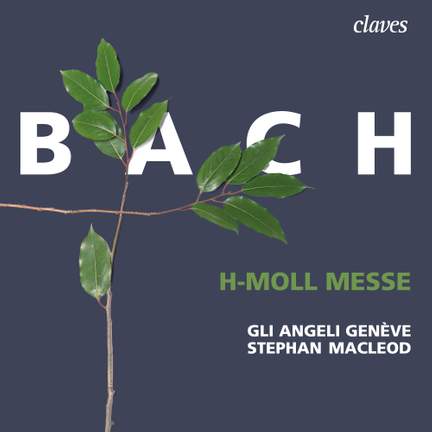
Bach: Mass in B minor
Aleksandra Lewandowska (soprano), Zoë Brookshaw (soprano), Marianne Beate Kielland (mezzo-soprano), Valerio Contaldo (tenor), Alex Potter (counter-tenor), Anne-Kathryn Olsen (soprano), Christelle Monney (mezzo-soprano), Olivier Coiffet (tenor), Jaromir Nosek (bass)
Gli Angeli Genève, Stephan...
Awards:
-
International Classical Music Awards, 2022, Nominated - Baroque Vocal

Overall, Gli Angeli Genève’s performance is characterised by swift momentum, crisp articulation and benevolent attention to detail.
Bach: Mass in B minor
Aleksandra Lewandowska (soprano), Zoë Brookshaw (soprano), Marianne Beate Kielland (mezzo-soprano), Valerio Contaldo (tenor), Alex Potter (counter-tenor), Anne-Kathryn Olsen (soprano), Christelle Monney (mezzo-soprano), Olivier Coiffet (tenor), Jaromir Nosek (bass)
Gli Angeli Genève, Stephan...
Purchase product
Awards:
-
International Classical Music Awards, 2022, Nominated - Baroque Vocal
Overall, Gli Angeli Genève’s performance is characterised by swift momentum, crisp articulation and benevolent attention to detail.
About
For years now, musicology and musicians have been addressing the question of the vocal forces that Johann Sebastian Bach had at his disposal for his cantatas and passions. With the help of occasionally newly discovered sources and in-depth studies, we have been able to find enlightening answers to a problem that is essential for the interpretation of his music.
From its creation in 2005, Gli Angeli Genève has approached Bach’s music with two singers per part: i. e. eight singers for most of the cantatas, eight singers for the St John Passion, sixteen for the St Matthew Passion and its two choirs (as our recording published by Claves in April 2020 shows), ten for the Magnificat (where the choirs have five parts) or for the Mass in B minor (where a complement of twelve singers would be more logical because of the six-part Sanctus). Two singers per part in the choirs is the number of singers in Carl Philip Emmanuel Bach’s choir for many of his great oratorios, and the number of singers in Joseph Haydn’s choir for many of his masses. But here again, these historical realities are not the basis of our approach and choice. A musician may be justified in his need to legitimize his aesthetic choices by his knowledge of history, but if the search for authenticity becomes the sole driving force behind his work, he may go astray. It is therefore another factor that attracts and motivates us.
Artists
Aleksandra Lewandowska (soprano), Zoë Brookshaw (soprano), Marianne Beate Kielland (mezzo-soprano), Valerio Contaldo (tenor), Alex Potter (counter-tenor), Anne-Kathryn Olsen (soprano), Christelle Monney (mezzo-soprano), Olivier Coiffet (tenor), Jaromir Nosek (bass)
Gli Angeli Genève, Stephan Macleod
Contents and tracklist
- Aleksandra Lewandowska, Zoë Brookshaw, Marianne Beate Kielland, Valerio Contaldo, Alex Potter, Anne-Kathryn Olsen, Christelle Monney, Olivier Coiffet, Jaromir Nosek
- Gli Angeli Genève
- Stephan Macleod
Awards and reviews
-
International Classical Music Awards2022Nominated - Baroque Vocal
 August 2021
Overall, Gli Angeli Genève’s performance is characterised by swift momentum, crisp articulation and benevolent attention to detail.