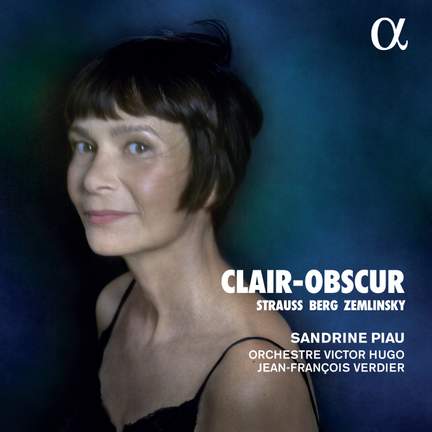
Clair-Obscur
Strauss - Berg - Zemlinsky
Sandrine Piau (soprano), Orchestre Victor Hugo Franche-Comté, Jean-François Verdier
Awards:
-
Presto Recording of the Week, 19th March 2021

-
Gramophone Magazine, May 2021, Editor's Choice

-
Gramophone Awards, 2021, Shortlisted - Voice & Ensemble

-
Presto Recordings of the Year, Finalist 2021

-
International Classical Music Awards, 2022, Nominated - Vocal

Shunning the velvety voluptuousness of a Jessye Norman or the wide-eyed textual probing of a Schwarzkopf, she brings a freshness of perspective that encourages the reconsideration of cherished...
Clair-Obscur
Strauss - Berg - Zemlinsky
Sandrine Piau (soprano), Orchestre Victor Hugo Franche-Comté, Jean-François Verdier
Purchase product
Awards:
-
Presto Recording of the Week, 19th March 2021
-
Gramophone Magazine, May 2021, Editor's Choice
-
Gramophone Awards, 2021, Shortlisted - Voice & Ensemble
-
Presto Recordings of the Year, Finalist 2021
-
International Classical Music Awards, 2022, Nominated - Vocal
Shunning the velvety voluptuousness of a Jessye Norman or the wide-eyed textual probing of a Schwarzkopf, she brings a freshness of perspective that encourages the reconsideration of cherished...
About
The dreamer! That double of our existence, that chiaroscuro of the thinking being , wrote Gaston Bachelard in 1961. The old is dying, the new cannot be born, and in that chiaroscuro, monsters appear, adds Antonio Gramsci. Sandrine Piau has chosen to use these two quotations as an epigraph to her new recording: My family and friends know about this obsession that never leaves me completely. The antagonism between light and darkness. The chiaroscuro, the space in between. . .This programme, recorded with the Orchestre Victor Hugo under its conductor Jean-François Verdier, who is also principal clarinettist of the Paris Opéra, travels between the chilly Rhenish forest of Waldgespräch, a ballad by Zemlinsky composed for soprano and small ensemble in 1895, the night of the first of Berg's Seven Early Songs (1905-08), and the sunlight of Richard Strauss's Morgen, which are followed by the Four Last Songs, composed in 1948, the first two of which, Frühling and September (evoking spring and autumn respectively) are also, as Sandrine Piau concludes, the seasons of life.
Contents and tracklist
Spotlight on this release
-
An error occurred.
Try watching this video on www.youtube.com, or enable JavaScript if it is disabled in your browser.
-
Strauss Lieder from Sandrine Piau and Daniel Behle
19th Mar 2021
The French soprano brings an uncommon freshness and flexibility to the Four Last Songs with the Orchestre Victor Hugo Franche-Comté, whilst Behle and his regular recital-partner Oliver Schnyder revel in the composer's coruscating attack on publishers in the rarely-recorded Der Krämerspiegel.

Awards and reviews
-
Presto Recording of the Week19th March 2021
-
Gramophone MagazineMay 2021Editor's Choice
-
Presto Recordings of the YearFinalist 2021
-
International Classical Music Awards2022Nominated - Vocal
 July 2021
Shunning the velvety voluptuousness of a Jessye Norman or the wide-eyed textual probing of a Schwarzkopf, she brings a freshness of perspective that encourages the reconsideration of cherished prejudices...Not only does Clair-Obscur bestride some illuminating and unexpected juxtapositions, it confirms – were such confirmation needed – Piau’s exuberant, allconquering versatility.
 May 2021
Piau’s voice is light and deftly controlled, and it’s matched beautifully by dappled orchestral accompaniment from the Besançon-based Orchestre ‘Victor Hugo’ and conductor Jean-François Verdier.
 19th March 2021
Piau approaches the Four Last Songs entirely on her own terms, making full use of the colours at her disposal but never manufacturing weight or darkness that doesn’t come naturally into the voice, and conductor Jean-François Verdier supports her at every turn; whilst there’s plenty of forward momentum in each song, the relatively swift tempi never short-change the music, and textures retain a refreshing translucence.