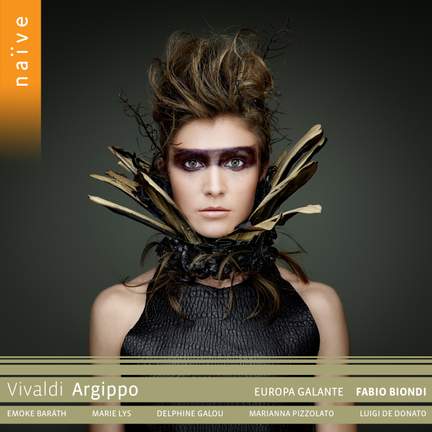
Special offer. Vivaldi: Argippo
Emőke Baráth (soprano), Marie Lys (soprano), Delphine Galou (contralto), Marianna Pizzolato (mezzo-soprano), Luigi De Donato (bass), Europa Galante, Fabio Biondi
Awards:
-
BBC Music Magazine, January 2021, Opera Choice

-
Presto Recording of the Week, 18th December 2020

Scholarship aside, what counts is whether Fabio Biondi directing Europa Galante finds satisfying music theatre in this collage. And so he does...Vivaldi’s musical fingerprints are everywhere...
Special offer. Vivaldi: Argippo
Emőke Baráth (soprano), Marie Lys (soprano), Delphine Galou (contralto), Marianna Pizzolato (mezzo-soprano), Luigi De Donato (bass), Europa Galante, Fabio Biondi
Purchase product
Awards:
-
BBC Music Magazine, January 2021, Opera Choice
-
Presto Recording of the Week, 18th December 2020
Scholarship aside, what counts is whether Fabio Biondi directing Europa Galante finds satisfying music theatre in this collage. And so he does...Vivaldi’s musical fingerprints are everywhere...
About
With this second contribution to the Vivaldi Edition, Fabio Biondi and his ensemble Europa Galante sign here the recording of the twentieth opera of the collection - a pasticcio in which Vivaldi ‘recycles’ hit tunes from the ‘World of Warcraft’ operas of his contemporaries.
More than any other, this work has, narrowly, escaped oblivion. The original score, composed by Vivaldi in 1730 for Vienna and Prague, having been lost. A meticulous reconstruction of the manuscript was carried out by the musicologist Bernardo Ticci - for whom Vivaldi’s music has no secrets - from several existing sources scattered in Eastern Europe (the booklets of the two productions, a collection of arias and a work Anonymous, enhanced with arias by Galeazzi, Pescetti, Hasse, Porpora, Fiorè and Vinci). This is the version of this pasticcio which is here recreated and recorded.
Lovers’ rivalries and family conflicts, accumulation of misunderstandings, upset feelings and exacerbated emotions are an inexhaustible source of inspiration for Vivaldi. The Venetian composer finds in the text of Domenico Lalli - librettist of several lyrical works inspired by the Empire moghol - all the springs conducive to a contrasting and always glowing writing at the fires of love to death: rowdy and fiery or even hallucinatory allegros, tender or anguished cantabile, writing ‘gallant’... virtuous in its vocality as well as in its instrumental lines, “this improbable opera bears the seal of an authentic Vivaldian pasticcio,” wrote Reinhard Strohm.
Particularly noteworthy is Zanaida’s aria di furore “Se lento ancora il fulmine” (Act I, Delphine Galou), Osira’s love tune “Vado a morir per te” (Act III, Marie Lys) and the “Da più venti combattut” of Act II (Emöke Baráth).
Contents and tracklist
- Delphine Galou (vocalist), Luigi De Donato (vocalist)
- Europa Galante
- Fabio Biondi
- Marianna Pizzolato (vocalist), Luigi De Donato (vocalist)
- Europa Galante
- Fabio Biondi
- Emőke Baráth (vocalist), Marie Lys (vocalist), Delphine Galou (vocalist), Marianna Pizzolato (vocalist), Luigi De Donato (vocalist)
- Europa Galante
- Fabio Biondi
- Delphine Galou (vocalist), Luigi De Donato (vocalist)
- Europa Galante
- Fabio Biondi
- Luigi De Donato (vocalist)
- Europa Galante
- Fabio Biondi
Awards and reviews
-
BBC Music MagazineJanuary 2021Opera Choice
-
Presto Recording of the Week18th December 2020
 January 2021
Scholarship aside, what counts is whether Fabio Biondi directing Europa Galante finds satisfying music theatre in this collage. And so he does...Vivaldi’s musical fingerprints are everywhere on the score – those driving violins with their urgent rhythms, careful word painting and at best characters revealed through their music...Of the women characters Delphine Galou’s Zanaida gets the pick of the arias in a recording that is bright and lets the singers lead, which is as it should be.
 July/August 2021
Conductor Fabio Bondi knows how to bring out the many nuances in order to make this succession of arias work together yet each one stand out. The Europa Galante period ensemble is well balanced, perfectly in sync, and able to give complete support to the singers.
 February 2021
Spirited recitatives are delivered rapidly. The title-role is performed adroitly by Emőke Baráth, and Argippo’s courageous wife Osira is sung with assertive fioriture and focused phrasing by Marie Lys. Delphine Galou is a vociferous tour de force as the embittered antagonist Zanaida but her singing also has masterful subtlety when tackling deceptively fiendish cantilena.
 18th December 2020
Though the title-character is naturally assigned several show-stopping arias, it’s Zanaida who is the beating heart of the opera, and Galou brings her to life in all her emotional complexity...Biondi’s energetic, imaginative direction is of course key to the success of the entire project, bringing real coherence to a work which could easily seem like Now That’s What I Call Music 1732: even the most pedestrian recitatives have drive and dramatic impetus.