Special offer. Monteverdi: L'Orfeo
I Gemelli, Emiliano Gonzalez Toro
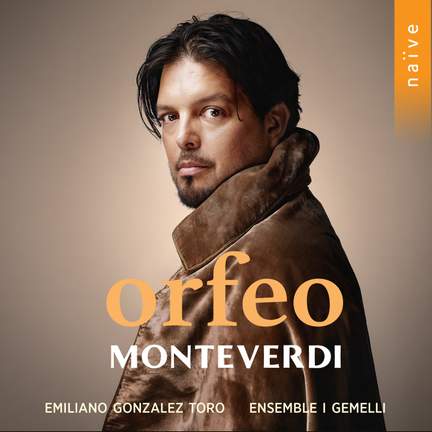
Awards:
-
Opera, December 2020

-
The Times Records of the Year, 2020

The result is sprightly orchestral playing, textures absolutely dripping with ornamentation and a proclivity for highly varied speeds...Emiliano Toro brings an easy fluencytotheroleofOrfeo,and...
Special offer. Monteverdi: L'Orfeo
I Gemelli, Emiliano Gonzalez Toro
Purchase product
Awards:
-
Opera, December 2020
-
The Times Records of the Year, 2020
The result is sprightly orchestral playing, textures absolutely dripping with ornamentation and a proclivity for highly varied speeds...Emiliano Toro brings an easy fluencytotheroleofOrfeo,and...
About
Monteverdi’s L’Orfeo - premiered in 1607 at the Ducal Palace in Mantua - is a unique masterpiece in its way of thinking and representing music that never ceases to inspire the greatest.
Emiliano Gonzalez Toro, at the heart of his ensemble I Gemelli, signs his third recording for naïve with this luxuriant reading refocused around the voice, which exalts both the aesthetics inherited from the Renaissance and the modernity of a virtuoso score.
This production, hailed on the stages of Paris and Toulouse at the end of 2019, has the singularity of being conducted ‘by the voice’ by the tenor, who plays the title role while directing singers and instrumentalists. Emiliano Gonzalez Toro displays his care - not only for himself but also for the ten soloists who surround him - with richly ornamented vocal lines that contrast in their dynamics and climates, always keeping the narration and interventions of the characters in tension.
From this fragmentation inherent in Striggio’s poem, which is also a model of proportions and balance for this favola in musica, the performers gathered here draw mobility and creativity, thanks to which recurrence is never repetitive and the pastoral scenes enhance moments of introspection such as “Rosa del cielo” (Act I), the famous “Tu se’ morta” (Act II) or the arrival of Orpheus in the Underworld in Act III (“Scorto da te”).
A continuo that is very inventive in its choice of timbres and accompaniment enriches the vocal and instrumental texture, dominated by the viols and enriched by a 1600 ceterone from the collections of the Musée de la Musique de Paris. The result is a true festive dimension, a powerful divine breath.
Contents and tracklist
- Emőke Baráth (soloist)
- Ensemble I Gemelli
- Emiliano Gonzalez Toro
- Zachary Wilder (soloist), Natalie Pérez (soloist), Alix Le Saux (soloist), Jérôme Varnier (soloist), Mathilde Etienne (soloist), Nicolas Brooymans (soloist), Fulvio Bettini (soloist), Juan Sancho (soloist), Alicia Amo (soloist), Emőke Baráth (soloist)
- Ensemble I Gemelli, Ensemble vocal de poche
- Emiliano Gonzalez Toro
- Alix Le Saux (soloist), Nicolas Brooymans (soloist), Zachary Wilder (soloist), Juan Sancho (soloist), Alicia Amo (soloist), Claudio Monteverdi, Alessandro Striggio, Natalie Pérez (soloist)
- Ensemble I Gemelli
- Emiliano Gonzalez Toro
- Claudio Monteverdi, Alessandro Striggio, Alix Le Saux (soloist), Jérôme Varnier (soloist), Nicolas Brooymans (soloist), Fulvio Bettini (soloist), Zachary Wilder (soloist), Juan Sancho (soloist)
- Ensemble I Gemelli, Ensemble vocal de poche
- Emiliano Gonzalez Toro
- Mathilde Etienne (soloist), Nicolas Brooymans (soloist), Fulvio Bettini (soloist), Zachary Wilder (soloist), Claudio Monteverdi, Alessandro Striggio, Jérôme Varnier (soloist), Juan Sancho (soloist), Emőke Baráth (soloist)
- Ensemble vocal de poche
- Ensemble I Gemelli, Emiliano Gonzalez Toro
- Fulvio Bettini (soloist), Claudio Monteverdi, Alessandro Striggio
- Ensemble I Gemelli
- Emiliano Gonzalez Toro
Awards and reviews
-
OperaDecember 2020
-
The Times Records of the Year2020
 January 2021
The result is sprightly orchestral playing, textures absolutely dripping with ornamentation and a proclivity for highly varied speeds...Emiliano Toro brings an easy fluencytotheroleofOrfeo,and he presents the central aria ‘Possente Spirto’ with great aplomb…In general the cast is good, with especially outstanding performances from Mathilde Etienne (as Proserpina) and Jêróme Varnier (as Caronte).
 December 2020
Gonzalez has a fine voice and gives ‘Possente spirto’, the geographical and spiritual heart of the work, a reading of great poetic beauty...Both in his own singing and in that of the other soloists, there is a keen collective sympathetic understanding of Monteverdi’s operatic language...This is a dramatic and lively reading given by a well-selected and carefully matched cast guided by a musician of sensitivity and imagination.
 December 2020
Toro describes how this Orfeo project fulfilled a long held ambition. It is one into which he has obviously put a great deal of thought...As a singer he brings to the role not only an intrinsically lovely timbre, but more importantly recognition that in this music it is text that maintains supremacy...All in all, with the exception of the lack of ornamentation, this is a highly rewarding Orfeo, executed with thoughtful understanding and sensitivity.
 4th October 2020
[Toro's] Orfeo is remarkable for both the fluency of his singing (the coloratura flourishes in Possente Spirto fall like pearls from his larynx) and his eloquent declaiming of Monteverdi’s recitar cantando...The supporting cast is packed with superb specialists: Emöke Barath, Natalie Perez, Jérôme Varnier and Fulvio Bettini, but it’s Toro’s set.