Special offer. Black Swan
Yuko Miyagawa (cello), Aki Kuroda (piano)
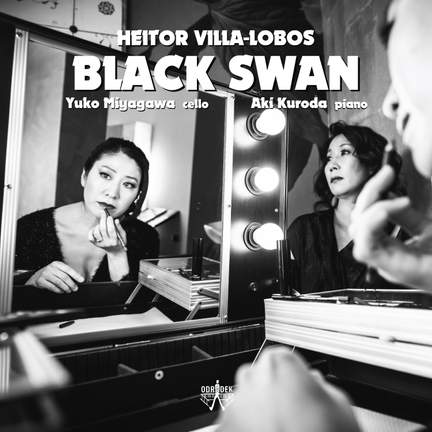
Special offer. Black Swan
Yuko Miyagawa (cello), Aki Kuroda (piano)
Purchase product
About
Black Swan is a rich and vibrant collection of music for cello and piano by Heitor Villa-Lobos, the 20th century’s most significant Brazilian composer of art music, performed by cellist Yuko Miyagawa and pianist Aki Kuroda, artists who are widely- known and celebrated in Japan, with growing international reputations.
Yuko Miyagawa is a household name in Japan; she has received widespread acclaim and numerous awards for her musicianship, with the Tokyo Mainichi newspaper prais- ing her “heart-touching” performances. Besides performing as a soloist with orchestras and in solo and chamber recitals, she often appears in collaboration with artists from diverse genres, while also visiting juvenile re-education homes and hospices to give per- formances, which she feels is her life’s vocation.
She hosts her own radio programme in Japan and is a regular guest on radio and television at the Japanese broadcasting company, NHK. Aki Kuroda’s Odradek debut Firebird was praised as “wondrous” by The Arts Desk: “Kuroda’s fearless precision pays huge dividends in such mercurial music...”
Villa-Lobos, who was a fine cellist as well as composer, combined European models with idiomatic Brazilian styles in a way that has shaped the course of Brazilian culture - and others besides - ever since. The works on this release span a fascinating period, from the 1910s to the 1940s, charting the trajectory of the composer’s development. The ‘Pequena Su te’ (‘Little Suite’) of 1913 is Villa-Lobos’ earliest published work for cello and piano, and reflects his love of Bach, which developed at an early age. This album’s title comes from the lyrical ‘O canto do cisne negro’ (‘The song of the black swan’) of 1917, adapted from the composer’s tone poem of the previous year. Villa-Lobos’ Cello Sonata No. 2 dates from a similar time and blends romanticism and impressionism, with both instruments acting as equal protagonists.
The love of Baroque music, and of Bach in particular, that germinated in early works such as the ‘Pequena Suite’, came to fruition in Villa-Lobos’ series of nine ‘Bachanias brasileiras’. ‘Bachianas brasileiras’ No. 2 dates from 1930; this album features the noble second movement ‘aria’ and the glorious final movement, which vividly evokes the ac- celeration of a small locomotive in Caipira, Sao Paolo. There is an arrangement of one of the ‘Ciclo brasileiro’ for piano from 1936, the shimmering ‘Impress es seresteiras’ (‘Evening impressions’), and a later work in the form of ‘Divaga o’ (‘Wandering’), from 1946. This quirky piece includes ad lib percussive effects, and is remarkable for its jaunty rhythms, sparse allusions to tonality, and improvisatory, recitative-like cello writing.
Contents and tracklist
- Aki Kuroda, Yuko Miyagawa
- Aki Kuroda, Yuko Miyagawa
- Aki Kuroda, Yuko Miyagawa
- Aki Kuroda, Yuko Miyagawa
- Aki Kuroda, Yuko Miyagawa
- Aki Kuroda, Yuko Miyagawa