Special offer. Hindemith: Kammermusik
Schleswig-Holstein Festival Orchestra, Christoph Eschenbach
Awards:
-
BBC Music Magazine, December 2020, Concerto Choice

It’s every bit as exciting as the first volume...[No. 4] opens with a pungent fanfare, its colours stemming from jazz-band instrumentation and the absence of orchestral violins. Stephen Waarts...
Special offer. Hindemith: Kammermusik
Schleswig-Holstein Festival Orchestra, Christoph Eschenbach
Purchase product
Awards:
-
BBC Music Magazine, December 2020, Concerto Choice
It’s every bit as exciting as the first volume...[No. 4] opens with a pungent fanfare, its colours stemming from jazz-band instrumentation and the absence of orchestral violins. Stephen Waarts...
About
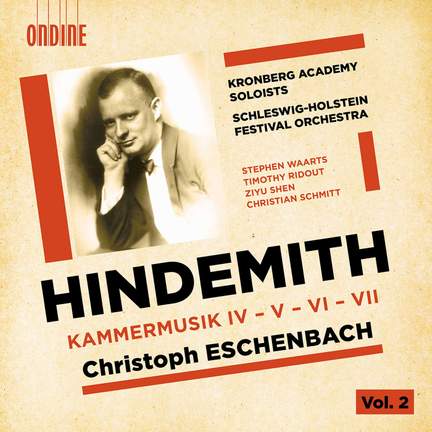
The final volume of Paul Hindemith’s(1895–1963) youthful and fresh Kammermusik series from the 1920s includes Kammermusik Nos. 4–7 performed by Kronberg Academy Soloists and the Schleswig-Holstein Festival Orchestra under a true Hindemith specialist, Christoph Eschenbach, who has won a Grammy for a previous Hindemith album on Ondine. These four works by Hindemith can be considered as full-bodied concertos for violin, viola, viola d’amore and organ. These work feature four young talented soloists, Stephen Waarts, Rimothy Ridout, Ziyu Shenand Christian Schmitt. Hindemith’s Kammermusik No. 4 (‘Violin Concerto’) is scored for a larger orchestra than its three predecessors and includes 24 instrumentalists. Kammermusik No. 5 (‘Viola Concerto’) the composer premiered himself by playing the solo part. In total, Hindemith performed this work for 85 times during the next 11 years! In a letter, Hindemith described the viola d’amore as “the most beautiful thing that you can imagine in sound”. The composer fell in love with the instrument and wrote his Kammermusik No. 6 with this instrument in mind. Hindemith’s final Kammermusik (No. 7) was written to a commission by the Southwest German Radio: the premiere of this Organ Concerto was transmitted live in 1928. The radio broadcast had a decisive role in the composer’s choice of instrumentation.
Contents and tracklist
- Stephen Waarts (violin)
- Kronberg Academy Soloists, Schleswig-Holstein Festival Orchestra
- Christoph Eschenbach
- Timothy Ridout
- Kronberg Academy Soloists, Schleswig-Holstein Festival Orchestra
- Christoph Eschenbach
- Ziyu Shen
- Kronberg Academy Soloists, Schleswig-Holstein Festival Orchestra
- Christoph Eschenbach
- Christian Schmitt
- Kronberg Academy Soloists, Schleswig-Holstein Festival Orchestra
- Christoph Eschenbach
Awards and reviews
-
BBC Music MagazineDecember 2020Concerto Choice
 December 2020
It’s every bit as exciting as the first volume...[No. 4] opens with a pungent fanfare, its colours stemming from jazz-band instrumentation and the absence of orchestral violins. Stephen Waarts plays the solo part with brilliant attack...Eschenbach has a special feeling for this music, and his project is well worth exploring.
 December 2020
As in Vol 1, Eschenbach relishes the music’s wild iconoclasm. Tempos are again lively and throughout he draws marvellous playing from the Kronberg Academy strings and Schleswig-Holstein Festival Orchestra’s winds (the trumpet not least!) and percussion...This really is the Kammermusiken for the 2020s.