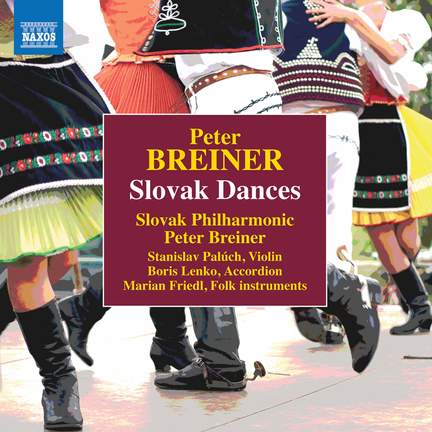
Peter Breiner: Slovak Dances
Slovak Philharmonic, Peter Breiner
All of the music is inventive and fun to listen to. It is all firmly tonal and many of the pieces are upbeat and energetic, save for a handful of statelier dances that provide a nice respite...
Peter Breiner: Slovak Dances
Slovak Philharmonic, Peter Breiner
Purchase product
All of the music is inventive and fun to listen to. It is all firmly tonal and many of the pieces are upbeat and energetic, save for a handful of statelier dances that provide a nice respite...
About
Peter Breiner is one of the world’s most performed composer/arrangers, with a boundless musicality that has led him to create fusions of music from a variety of genres. Drawing on traditions established by Brahms and Dvorák and showcasing leading folk music soloists, his Slovak Dances are an exuberant and kaleidoscopic monument rooted in Slovak musical folklore. It comprises 16 symphonic fantasias on songs that evoke varying emotions with an autobiographical element that follows Breiner’s life from his origins in Humenné and Košice to New York. Peter Brenier boasts over 200 albums released and multiple streams and downloads. Known as a conductor, composer, pianist and arranger, he has conducted, often doubling as a pianist, the Royal Philharmonic Orchestra, the Bournemouth, Jerusalem, New Zealand, Moscow and Polish National Radio Symphony Orchestras, the Hong Kong Philharmonic Orchestra, the Slovak Philharmonic and the Orchestre National de France, to mention just a few. His compositions and arrangements have been played in concerts and broadcast worldwide, and some of the most prestigious ballet companies have used his music in numerous performances.
Contents and tracklist
- Boris Lenko (accordion), Albert Hrubovčák (trombone), Marian Friedl (whistle), Marian Marian (whistle), Robert Vizváry (double bass), Stanislav Palúch (violin)
- Slovak Philharmonic Orchestra
- Peter Breiner
Awards and reviews
 May/June 2021
All of the music is inventive and fun to listen to. It is all firmly tonal and many of the pieces are upbeat and energetic, save for a handful of statelier dances that provide a nice respite from the jollity. One can certainly hear strong influences from Dvořák and even early Bartók in the Slavic melodies and orchestration, but Breiner carves out his own path with such inventive use of uncommon instruments.