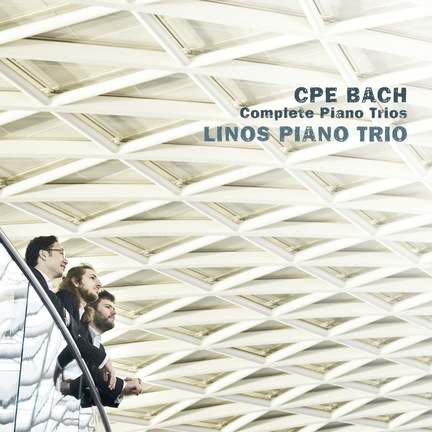
Special offer. CPE Bach Complete Piano Trios
Linos Piano Trio
The performance by the Linos Trio is excellent, demonstrating with ease and sensitivity the fine details of the music. The violin of Konrad Elias-Trautman is often relegated to the distant background,...
Special offer. CPE Bach Complete Piano Trios
Linos Piano Trio
Purchase product
The performance by the Linos Trio is excellent, demonstrating with ease and sensitivity the fine details of the music. The violin of Konrad Elias-Trautman is often relegated to the distant background,...
About
First Prize and Audience Prize winner of the Melbourne International Chamber Music Competition 2015, the Linos Piano Trio is increasingly recognised as one of Europe's most creative and dynamic trios. They are delighted to present their new album of CPE Bach's Complete Piano Trios.
In Hamburg, 1775, Carl Philipp Emanuel Bach, by then an internationally celebrated and well-connected figure, was surely aware of the genre's popularity. After all, his half-brother, the London-based Johann Christian, was central in promoting this new culture of domestic piano playing.
Responsive to the market demand, C.P.E. Bach came to an agreement with the London publisher Bremner to publish the following year Six Sonatas for the Harpsichord or Pianoforte accompanied by Violin and Violoncello (Wq. 89). Despite the title, Bach referred to these works at times as Trios, at times as Sonatas, and sometimes even as "Trios (which are also Solos)".
It seems he didn't really know what to call them, as they sat in between his previously clear categories of Trios (in the Baroque trio-sonata format of two equal instrumental parts accompanied by basso continuo), keyboard solo works, and the "Soli" (works for various solo instruments to be accompanied by the continuo). His ambivalence towards this fashionable new genre was evident in a letter where he contemptuously referred to the accompanied sonatas as a "non- or half-entity".
But regardless, the publication was exceedingly successful, and Bach enjoyed what he probably considered a nice bonus to his usual duties of writing religious choral works: "I am having more luck than I have the right to expect. People are crazy about my modest concoction, from which one may profit." He published two further sets (Wq. 90 and 91) with Breitkopf in Germany in 1776 and 1777, to great success.
Business acumen aside, these works reveal C.P.E. Bach at the height of his career and are full of invention, expression, and shocking surprises that at times surpass what even Beethoven might dare to do.. .." (Excerpt from the liner notes by LINOS PIANO TRIOS)
Contents and tracklist
- arr. for piano trio
- Linos Piano Trio
- arr. for piano trio
- Linos Piano Trio
- arr. for piano trio
- Linos Piano Trio
- arr. for piano trio
- Linos Piano Trio
- arr. for piano trio
- Linos Piano Trio
- arr. for piano trio
- Linos Piano Trio
- arr. for piano trio
- Linos Piano Trio
- arr. for piano trio
- Linos Piano Trio
- arr. for piano trio
- Linos Piano Trio
- arr. for piano trio
- Linos Piano Trio
- arr. for piano trio
- Linos Piano Trio
- arr. for piano trio
- Linos Piano Trio
- arr. for piano trio
- Linos Piano Trio
Awards and reviews
 Jan/Feb 2021
The performance by the Linos Trio is excellent, demonstrating with ease and sensitivity the fine details of the music. The violin of Konrad Elias-Trautman is often relegated to the distant background, but the cello portion of Vladimir Waltham lends depth to the bass lines. Of course, the central focus is on the playing of Prach Boondiskulchok, which is quite attuned to Bach’s shifts, accomplishing these with ease.
 October 2020
The playing is smart, efficient and alert to Bach’s quicksilver changes of mood and material. But it also seems to be hampered by the decision to think of these works as trios...Bach’s keyboard-writing is so idiosyncratic, so mercurial in its twists and turns, that one wants the soloist to be just that, a soloist. A committee approach, with judicious collaboration, doesn’t work nearly so well. Nevertheless, there is much to admire in the Linos reading.