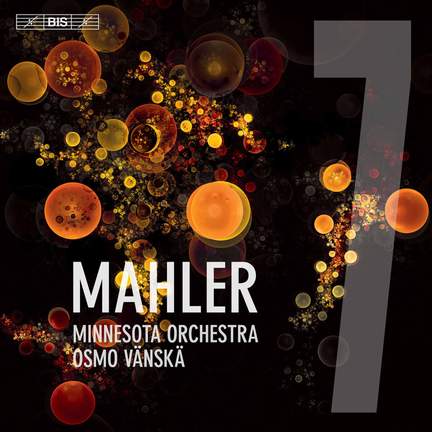
Mahler: Symphony No. 7
Minnesota Orchestra, Osmo Vänskä
Awards:
-
Record Review, 27th June 2020, Record of the Week

-
Gramophone Magazine, September 2020, Editor's Choice

Vänskä’s apparent eccentricities here are mostly to accentuate Mahler’s own in his most outlandish ad unpredictable symphony…All the brass do the Minnesota Orchestra proud, and if the strings...
Mahler: Symphony No. 7
Minnesota Orchestra, Osmo Vänskä
Purchase product
Awards:
-
Record Review, 27th June 2020, Record of the Week
-
Gramophone Magazine, September 2020, Editor's Choice
Vänskä’s apparent eccentricities here are mostly to accentuate Mahler’s own in his most outlandish ad unpredictable symphony…All the brass do the Minnesota Orchestra proud, and if the strings...
About
In an effort to arrange the first performance of his Seventh Symphony, Gustav Mahler declared it to be his best work, ‘preponderantly cheerful in character’. His younger colleague Schoenberg expressed his admiration for the work, and Webern considered it his favorite Mahler symphony. Nevertheless, it remains the least performed and least written-about symphony of the entire cycle, and has come to be regarded as enigmatic and less successful than its siblings. One reason for this has been the huge – even for Mahler – contrasts that it encompasses: from a first movement which seems to continue the atmosphere of the previous symphony, the ‘Tragic’ Sixth, to a finale that has been accused of excessive triumphalism, and which Mahler himself once described as ‘broad daylight’. Between these two poles, he supplies no less than two movements entitled Nachtmusik (‘night music’) framing a scherzo to which the composer added the character marking schattenhaft (‘shadowy’). Mahler famously said that ‘a symphony must be like the world. It must embrace everything.’ The Seventh is as true to this dictum as any other of the symphonies, offering a wealth of emotions, moods and colours. The composer makes full and imaginative use of the orchestra’s extended wind and percussion sections – including cowbells, whips and glockenspiel – as well as a mandolin and a guitar, adding a troubadour-like aspect to the nightly serenade of the fourth movement. All of this is brought to life by the players of the Minnesota Orchestra under Osmo Vänskä, as they continue a cycle praised for the performances as well as the recorded sound.
Contents and tracklist
Awards and reviews
-
Record Review27th June 2020Record of the Week
-
Gramophone MagazineSeptember 2020Editor's Choice
 September 2020
Vänskä’s apparent eccentricities here are mostly to accentuate Mahler’s own in his most outlandish ad unpredictable symphony…All the brass do the Minnesota Orchestra proud, and if the strings aren’t up to central-European richness, Vänskä usually moulds them to produce the desired effect…The sounds are beguiling to the last, and the essential triumph of engineering in this most testing of symphonies is peerless.
 September/October 2020
Vänskä does a good job at surrendering to the momentum, in a reading that sounds free and unhindered. The essential joy of the finale comes through without sounding heavy-handed or galumphing. Another point of praise is that the finale sounds like it belongs with the rest of the symphony, which isn’t easy to pull off.
 September 2020
I might have predicted that this of all the Mahler symphonies would chime with Osmo Vänskä’s very particular gifts as a conductor. The brilliance and clarity of this performance (and recording – BIS’s technical prowess much in evidence), to say nothing of Vänskä’s way with rhythm and articulation, is in itself the source of much pleasure.