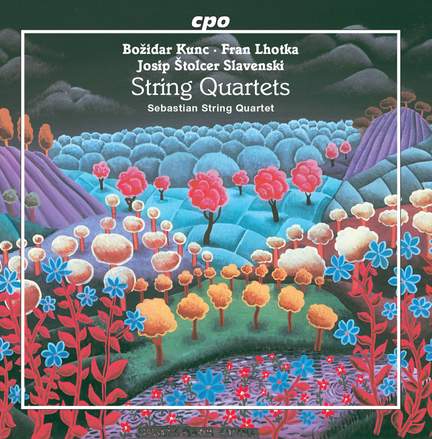
Kunc, Lhotka and Slavenski: String Quartets
Sebastian String Quartet
All three works belong to the turbulent climate of the 1930s, and they mirror the troubled lyricism and expanded tonal techniques of quartets by more celebrated contemporaries such as Bloch,...
Kunc, Lhotka and Slavenski: String Quartets
Sebastian String Quartet
Purchase product
All three works belong to the turbulent climate of the 1930s, and they mirror the troubled lyricism and expanded tonal techniques of quartets by more celebrated contemporaries such as Bloch,...
About
Music from the Sebastian String Quartet’s native Croatia, by Croatian composers or by composers who spent a significant part of their careers in Croatia, forms a special focus in this ensemble’s work. Boźidar Kunc was one of the most distinguished Croatian composers of the twentieth century as well as an extraordinary pianist who was known as »the Croatian poet of the piano.« His only String Quartet very freely treats tonality, expands its space through the linking of various instrumental parts, and often uses them as a colorful backdrop for melodies full of imaginative aspiration in which traces of folkloristic idiom sometimes come into view. The Czech composer Fran Lhotka exercised a strong influence on the Croatian music scene for more than fifty years. Lhotka’s captivating Elegy and Scherzo proves to be a fascinating work with contrasting themes invented in the spirit of folk music. Josip Štolcer Slavenski compiled one of the most interesting and most unusual life’s works that Croatian music of the twentieth century has to offer. He composed powerful and unconventional works without direct models or formal and stylistic determinants. In 1938 he wrote his fourth and last Quartet to Balkan dance music and with highly varied and finely crafted themes. All these pieces have in common folkloristic expression and elemental power with a lasting impact.
Contents and tracklist
- Sebastian String Quartet
- Sebastian String Quartet
- Sebastian String Quartet
Awards and reviews
 October 2020
All three works belong to the turbulent climate of the 1930s, and they mirror the troubled lyricism and expanded tonal techniques of quartets by more celebrated contemporaries such as Bloch, Milhaud and Bridge. I would be pleased to hear any of them live, especially in performances as assured and wholehearted as these.