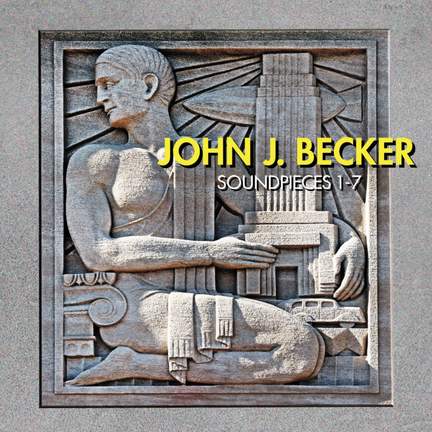
Special offer. John J. Becker: Soundpieces 1-7
Joseph Kubera, FLUX Quartet, Conrad Harris, Vasko Dukovski, Margaret Lancaster, Adam Tendler
[Becker] He’s an important figure many of us know by reputation but not by work. This release (incidentally, all of which is authoritatively performed) makes the best possible case for his profile...
Special offer. John J. Becker: Soundpieces 1-7
Joseph Kubera, FLUX Quartet, Conrad Harris, Vasko Dukovski, Margaret Lancaster, Adam Tendler
Purchase product
[Becker] He’s an important figure many of us know by reputation but not by work. This release (incidentally, all of which is authoritatively performed) makes the best possible case for his profile...
About
John J. Becker (1886-1961) is the least known of a group of composers who, by reputation, became known as “the American Five,” analogous to the better-known “Russian Five” or “French Six.”
Becker’s cohorts consisted of Carl Ruggles, Henry Cowell, Wallingford Riegger, and Charles Ives. Ives, born 1874, was the oldest of the group and Cowell, born 1897, was the youngest, and in the 1920s and ‘30s they were known as the most radical and dissonant of American composers.
Becker could be briefly summarised as a confluence of dissonance and Catholicism. He became known as one of the leading proponents of a style invented by musicologist/composer Charles Seeger (1886-1979), who had been one of Cowell’s mentors, known as dissonant counterpoint, an idiom in which the traditional rules of counterpoint were reversed to produce maximum dissonance rather than consonance.
In his own writings about Becker, Cowell emphasised his ties to Renaissance church polyphony, calling him “a Sixteenth-Century modern.” For a promotional pamphlet Becker produced, Cowell wrote that Becker “bases his style on the art of the great vocal polyphonists, de Lassus, Palestrina, Victoria, etc. Using their breadth and religious feeling, he has poured his own modern materials into the old polyphonic forms.”
Elsewhere Becker can fall into a kind of modernist simulacrum of Classical-era style, in conventional four-part textures differentiated by the harshness of dissonant intervals between moving lines. He picked up Cowell’s passion for tone clusters, often pitting black keys on the piano against white (in common with some other early moderns like Stravinsky and Ornstein), and he made a notational fetish of large sharps and flats that were intended to apply to an entire chord. In his music, he said, there was no dissonance, because “dissonance replaced consonance as the norm.”
Along with the Symphonia Brevis, the Concerto Arabesque, and a motoric percussion ensemble piece called The Abongo (which the percussion-loving Cage expressed admiration for), Becker’s seven chamber works abstractly called Soundpieces have proved the most public part of his output. This is the first recording to bring them altogether, and indeed the first commercial recording of several of them. That John Becker will remain the least-celebrated member of the American Five is probably inevitable. But at his best he achieves considerable eloquence in the then-new idiom of dissonant counterpoint, and a textural momentum and energy that seem all his own.
Contents and tracklist
- Joseph Kubera, FLUX Quartet
- FLUX Quartet
- FLUX Quartet
- Joseph Kubera, Conrad Harris
- Joseph Kubera
- Vasko Dukovski, Margaret Lancaster
- Adam Tendler, Joseph Kubera
Awards and reviews
 Jul/Aug 2020
[Becker] He’s an important figure many of us know by reputation but not by work. This release (incidentally, all of which is authoritatively performed) makes the best possible case for his profile and vision.