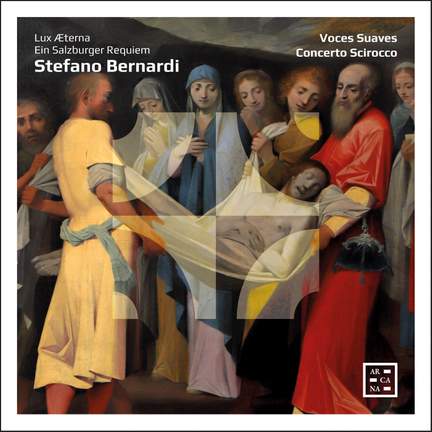
Special offer. Bernardi: Lux Aeterna & Ein Salzburger Requiem
Concerto Scirocco, Voces Suaves
Awards:
-
Diapason d’Or, February 2020, Découverte

To get an idea of the soundworld of Stefano Bernardi, an Italian plying his trade in early-17th-century Salzburg, think Monteverdi but without the flamboyance. He benefits from nicely nuanced...
Special offer. Bernardi: Lux Aeterna & Ein Salzburger Requiem
Concerto Scirocco, Voces Suaves
Purchase product
Awards:
-
Diapason d’Or, February 2020, Découverte
To get an idea of the soundworld of Stefano Bernardi, an Italian plying his trade in early-17th-century Salzburg, think Monteverdi but without the flamboyance. He benefits from nicely nuanced...
About
After rediscovering the music of Giovanni Croce, maestro di cappella at St Mark’s cathedral in Venice (A439), Ensembles Voces Suaves & Concerto Scirocco take us to Salzburg and put the spotlight on the Verona-born composer Stefano Bernardi, a contemporary of Monteverdi. Bernardi reached the peak of his career in Salzburg, when he was appointed the first Kapellmeister of its newly constructed cathedral, a position he held from 1628 to 1634. Bernardi contributed greatly to the integration of the Italian nuovo stile in Salzburg, especially of features such as polychorality and the stile concertato, and may therefore be seen as the musical forefather of later, more famous Salzburg musicians. The outstanding stature of his music is clearly evident from his majestic Requiem, the manuscript of which is still preserved in the Salzburg cathedral archives. Particularly impressive is the Sequentia, which forms the core of the work and opens with an elaborate Dies irae section, based on the famous chant melody. The Requiem, as well as a number of Motets by Bernardi, is recorded here for the very first time.
Contents and tracklist
- Concerto Scirocco, Voces Suaves
- Concerto Scirocco, Voces Suaves
- Concerto Scirocco, Voces Suaves
- Concerto Scirocco, Voces Suaves
Awards and reviews
-
Diapason d’OrFebruary 2020Découverte
 April 2020
To get an idea of the soundworld of Stefano Bernardi, an Italian plying his trade in early-17th-century Salzburg, think Monteverdi but without the flamboyance. He benefits from nicely nuanced performances here.
 Jul/Aug 2020
They approach the music with calm sobriety, favoring understated virtuosity over histrionics. This pays off handsomely, capturing both the serenity of prima prattica polyphony and the more dramatic concerted style that was modern at the time...the ensemble balance and blend are consistently even, and the woodwind and brass playing in particular is sophisticated, nuanced and impeccable, technically. This is a fine recording on all counts.