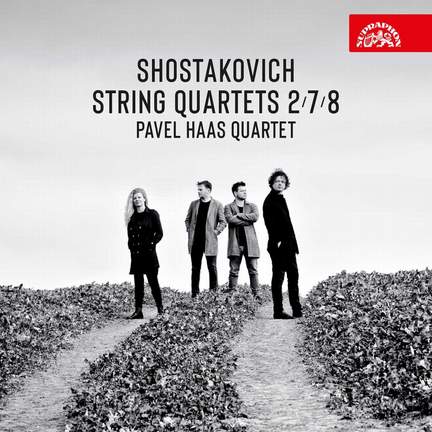
Shostakovich: String Quartets Nos. 2, 7 and 8
Pavel Haas Quartet
Awards:
-
Presto Recording of the Week, 1st November 2019

-
Presto Recordings of the Year, Finalist 2019

-
The Times Records of the Year, 2019

-
Building a Library, January 2023, Recommended Recording

They make interpretive decisions that are unexpected but none the less to me felt deeply initiative and this passage showcases the gorgeous cello line that has extraordinary shaping in how you...
Shostakovich: String Quartets Nos. 2, 7 and 8
Pavel Haas Quartet
Purchase product
Awards:
-
Presto Recording of the Week, 1st November 2019
-
Presto Recordings of the Year, Finalist 2019
-
The Times Records of the Year, 2019
-
Building a Library, January 2023, Recommended Recording
They make interpretive decisions that are unexpected but none the less to me felt deeply initiative and this passage showcases the gorgeous cello line that has extraordinary shaping in how you...
About
Shostakovich – his music is a challenge each and every quartet sooner or later has to face up to. Yet when it comes to the Pavel Haas Quartet, it seems to be in their very DNA. The ensemble’s unbridled, impulsive and, now and then, frenetic energy, sense for extreme contrast, ability to bring to bear gradation from breath-taking subtlety and tenderness to symphonic drama are facets essentially incident to Shostakovich’s music.
Although composed in safety, away from the horrors of World War II, String Quartet No. 2 (1944) reflects the suffering, uncertainty and anxiety of living at the time (the lyrical recitative of the second movement, as performed by Veronika Jarůšková, the first violin). Both dating from 1960, String Quartets Nos. 7 and 8 are truly intimate confessions. While Shostakovich dedicated the former (the shortest piece of the cycle) to the memory of his first wife, he most likely intended the latter as his own epitaph, at the time when be hovered on the thin line between life and death. Attesting to the autobiographical nature of String Quartet No. 8 is the opening DSCH motif, Shostakovich’s musical signature, which reoccurs throughout the piece.
Contents and tracklist
Spotlight on this release
-
An error occurred.
Try watching this video on www.youtube.com, or enable JavaScript if it is disabled in your browser.
-
Shostakovich from the Pavel Haas Quartet
1st Nov 2019
The serial award-winners surpass even their own high standards with searing accounts of the Second, Seventh and Eighth String Quartets on Supraphon.
-
The Pavel Haas Quartet on Shostakovich
1st Nov 2019
Three members of the Quartet share their thoughts on their new album and their upcoming recital and recording plans...


Awards and reviews
-
Presto Recording of the Week1st November 2019
-
Presto Recordings of the YearFinalist 2019
-
The Times Records of the Year2019
Building a Library 21st January 2023
They make interpretive decisions that are unexpected but none the less to me felt deeply initiative and this passage showcases the gorgeous cello line that has extraordinary shaping in how you hear them just briefly melt away and then return. Really intelligent attention to detail.
 November 2019
Shostakovich’s Second Quartet is remarkable for its sheer insistence...The Pavel Haas register all this to the nth degree, and I would have been inclined to hail this one of the finest of all recorded accounts had they only brought more coiled tenseness to the shadowy outer sections of the Waltz third movement.
 1st November 2019
What we have here is one of the bleakest and most beautiful recordings of the year, with all three quartets (particularly the much-recorded No. 8) approached with an immediacy that would make you swear that the ink was barely dry on the page. They can summon a massive, quasi-orchestral sound when required, so much so that there were moments in the Eighth Quartet when I was convinced I was listening to the piece in Rudolf Barshai’s arrangement for string orchestra.
 24th November 2019
The Czech players are always worth hearing, especially in their angst-ridden account of the biographical C minor quartet (No 8), but also in the forlorn, if fleeting, F sharp minor (No 7), written in memory of his first wife. Their account of the Second Quartet, in A major, is spacious, intense and symphonically conceived.