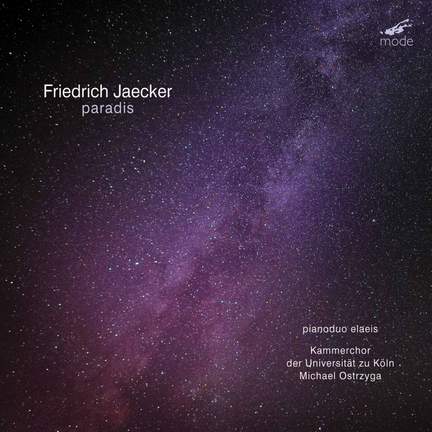
Paradis
Jovita Zähl (piano), Philipp Kronbichler (piano)
Chamber Choir of the University of Cologne, Michael Ostrzyga
[paradis] here the textures are open and spare, and this allows the sounds made by the pianos’ mechanisms themselves to come into the foreground. I find this magical and mysterious, and even...
Paradis
Jovita Zähl (piano), Philipp Kronbichler (piano)
Chamber Choir of the University of Cologne, Michael Ostrzyga
Purchase product
[paradis] here the textures are open and spare, and this allows the sounds made by the pianos’ mechanisms themselves to come into the foreground. I find this magical and mysterious, and even...
About
"American composer Harry Partch developed a system of intonation in which the exact tuning of spectral sounds and their inversions are made possible. In Harry’s Dream, each of the thirty-three musicians are responsible for a single note played on a tuned wine glass. Each glass — tuned precisely to the (microtonal) cent — helps to build a tremendous “glass harp,” in which the listener is enveloped by a mass of sounds.
The cosmic theme, the just intonation and the unique instrumentation of Harry’s Dream, offers a complete contrast to the intimacy portrayed in Bagatellen & Studien, written for solo piano. Composed between 2007 and 2012, each of the twenty-four miniatures represents a unique style. The contrasting profile of the Bagatelles and Studies — compared to Preludes and Fugues — becomes especially clear if they are alternately performed by two pianists at two pianos, as on this recording.
Friedrich Jaecker’s paradis (paradise), written in 2013, unites both instruments, forming a delicate array of sounds mostly within the pianos’ upper octaves. The composition is thinned out — even to the point that only a single canonic line often remains. The fainted image of beauty lingers in the air, leaving one to ask if the beauty had ever been present, or in the spherical sounds simply suggested."
Contents and tracklist
- Chamber Choir of the University of Cologne
- Michael Ostrzyga
- Jovita Zähl (piano)
- Philipp Kronbichler (piano)
Awards and reviews
 January/February 2020
[paradis] here the textures are open and spare, and this allows the sounds made by the pianos’ mechanisms themselves to come into the foreground. I find this magical and mysterious, and even beautiful, but it is anything but mood music, in the usual sense of that phrase. Despite Jaecker’s influences (not just Ligeti and Feldman, but perhaps also Scelsi), this strikes me as excitingly original and unusual music, and it well worth your attention,