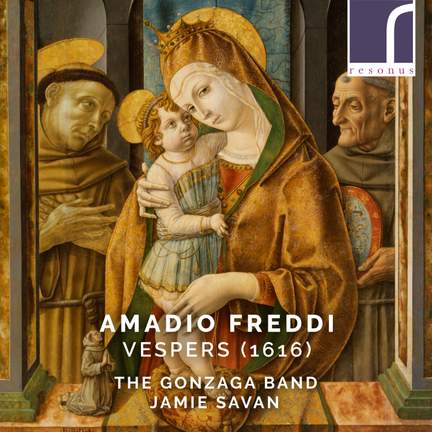
Amadio Freddi: Vespers (1616)
The Gonzaga Band, Jamie Savan
Compared with Monteverdi’s lavish 1610 vespers, Freddi’s resources are modest…, yet the music is remarkably varied – here rapt and contemplative, there extravagantly virtuosic. The six soloists...
Amadio Freddi: Vespers (1616)
The Gonzaga Band, Jamie Savan
Purchase product
Compared with Monteverdi’s lavish 1610 vespers, Freddi’s resources are modest…, yet the music is remarkably varied – here rapt and contemplative, there extravagantly virtuosic. The six soloists...
About
Following the international success of their first album on Resonus, Venice 1629, Jamie Savan with his acclaimed period group The Gonzaga Band continue their exploration of lesser-known music in the Venetian orbit. Here they uncover a forgotten masterpiece by Amadio Freddi, maestro di cappella of Treviso Cathedral during Monteverdi’s tenure at St Mark’s in Venice. Luminous vocal textures and sparkling instrumental writing, together with harmonic originality and melodic invention combine to reveal a fascinating composer with a unique voice, heard again for the first time in this world premiere recording. The Gonzaga Band was formed by cornettist Jamie Savan in 1997, with a mission to explore the intimate relationship between vocal and instrumental performance practice in the Early Modern period. The ensemble takes its name from the ducal family of Mantua: the Gonzagas were powerful and influential patrons of the arts in the late Renaissance, who employed Claudio Monteverdi as their maestro della musica at the turn of the seventeenth century. Monteverdi wrote some of his most innovative music for the Gonzagas: his third, fourth and fifth books of madrigals, the operas Orfeo and Arianna, and of course the Vespers of 1610.
Contents and tracklist
- The Gonzaga Band
- Jamie Savan
- The Gonzaga Band
- Jamie Savan
- The Gonzaga Band
- Jamie Savan
- Steven Devine
- The Gonzaga Band
- Jamie Savan
- The Gonzaga Band
- Jamie Savan
- The Gonzaga Band
- Jamie Savan
- The Gonzaga Band
- Jamie Savan
- The Gonzaga Band
- Jamie Savan
- Steven Devine
- The Gonzaga Band
- Jamie Savan
- The Gonzaga Band
- Jamie Savan
- The Gonzaga Band
- Jamie Savan
- Steven Devine
- The Gonzaga Band
- Jamie Savan
- The Gonzaga Band
- Jamie Savan
- The Gonzaga Band
- Jamie Savan
- The Gonzaga Band
- Jamie Savan
- The Gonzaga Band
- Jamie Savan
- Steven Devine
- The Gonzaga Band
- Jamie Savan
- The Gonzaga Band
- Jamie Savan
Awards and reviews
 December 2019
Compared with Monteverdi’s lavish 1610 vespers, Freddi’s resources are modest…, yet the music is remarkably varied – here rapt and contemplative, there extravagantly virtuosic. The six soloists are fresh-voiced and finely balanced, and they all offer stylish and cleanly enunciated readings.
 January/February 2020
The voices are lovely (a colleague compared Newton to Emma Kirkby) and the instrumental playing is accomplished. The band has mastered the Italian Baroque style to a high degree, and Savan knows the repertoire so well that he can find something to fit each slot in his program. Of the other singers, Steven Harrold’s name leapt out as a familiar one that can be found in every British vocal ensemble.
 Awards Issue 2019
There are graceful weightlessness, devotional intimacy, overlapping contrapuntal details that pull the ear, and ingenious hints at larger-scale polychoral splendour…The Gonzaga Band’s classy musicianship and intrepid curiosity reaffirm that there are riches to be found among Monteverdi’s overlooked contemporaries.
 25th August 2019
Whether or not he knew Monteverdi’s famous version of the Vespers, Freddi’s music has its own virtues. Less brilliant in impact, it has clear, light textures with unusual voice-instrument combinations...This kind of loving scholarship, combined with excellent performance by the Gonzaga Band’s six singers and three instrumentalists, contributes to our ever-growing picture of music in the late Renaissance and early baroque.
classicalsource.com October 2019
With texts included and the Vesper settings claimed as world premiere recordings, this is an important addition to the catalogue of Baroque choral music.