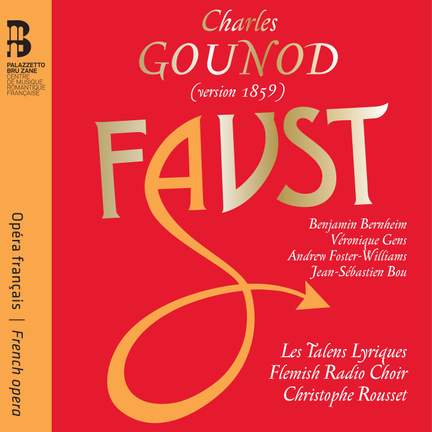
Gounod: Faust
1859 version
Benjamin Bernheim (Faust), Véronique Gens (Marguerite), Andrew Foster-Williams (Méphistophélès), Jean-Sébastien Bou (Valentin), Juliette Mars (Siebel), Ingrid Perruche (Marthe), Anas Séguin (Wagner/Un mendiant)
Les Talens Lyriques, Flemish Radio Choir, Christophe Rousset
Awards:
-
Gramophone Magazine, November 2019, Editor's Choice

-
Presto Recordings of the Year, Finalist 2019

-
International Classical Music Awards, 2019, Nominee - Opera

-
The Times Records of the Year, 2019

-
BBC Music Magazine Awards, 2020, Finalist - Opera

-
International Opera Awards, 2020, Nominated - Complete Opera Recording

-
Opus Klassik Awards, 2020, Nominee - Female Singer of the Year (Gens)

-
Opus Klassik Awards, 2020, Winner - Opera (19th-century)
-
Gramophone Awards, 2020, Finalist - Opera

Tenor Benjamin Bernheim is a superb Faust, with a bright and lovely lyric voice that is also comfortable in the lower tessitura of act I. As Marguerite, soprano Véronique Gens is an ideal romantic...
Gounod: Faust
1859 version
Benjamin Bernheim (Faust), Véronique Gens (Marguerite), Andrew Foster-Williams (Méphistophélès), Jean-Sébastien Bou (Valentin), Juliette Mars (Siebel), Ingrid Perruche (Marthe), Anas Séguin (Wagner/Un mendiant)
Les Talens Lyriques, Flemish Radio Choir, Christophe Rousset
Purchase product
Awards:
-
Gramophone Magazine, November 2019, Editor's Choice
-
Presto Recordings of the Year, Finalist 2019
-
International Classical Music Awards, 2019, Nominee - Opera
-
The Times Records of the Year, 2019
-
BBC Music Magazine Awards, 2020, Finalist - Opera
-
International Opera Awards, 2020, Nominated - Complete Opera Recording
-
Opus Klassik Awards, 2020, Nominee - Female Singer of the Year (Gens)
-
Opus Klassik Awards, 2020, Winner - Opera (19th-century)
-
Gramophone Awards, 2020, Finalist - Opera
Tenor Benjamin Bernheim is a superb Faust, with a bright and lovely lyric voice that is also comfortable in the lower tessitura of act I. As Marguerite, soprano Véronique Gens is an ideal romantic...
About
Gounod contemplated a Faust opera as early as his residence in Rome in the 1840s. But almost twenty years were to elapse before one of the most famous works of French Romanticism was premiered at the Théâtre-Lyrique (1859). Its debut at the Opéra in 1869 propelled the work into theatres all over the world, but numerous modifications were the price of achieving that fame.
Between the Faust of 1859 and its counterpart of 1869, some of the spirit has evaporated: the spontaneity of the spoken dialogue and melodrama, the pawky humour of Dame Marthe, the cynicism of Méphistophélès. We have forgotten the charm of the first tenors who sang ‘Salut, demeure chaste et pure’ with the timbre typical of the voix mixte of opéra-comique. Moreover, a large number of pieces were consigned to oblivion by these modifications. To discover this first Faust is to gain a deeper insight into the French aesthetic of demi-caractère, so specific to Paris in the 1850s.
Contents and tracklist
- Les Talens Lyriques, Véronique Gens, Benjamin Bernheim, Thibaud Epp, Andrew Foster-Williams, Jean-Sébastien Bou, Flemish Radio Choir, Juliette Mars, Ingrid Perruche, Anas Séguin
- Christophe Rousset
Spotlight on this release
-
An error occurred.
Try watching this video on www.youtube.com, or enable JavaScript if it is disabled in your browser.
-
Christophe Rousset on Lully and Gounod
14th Nov 2019
The French harpsichordist and conductor talks to Katherine about recording Lully's 1677 opera Isis (out now on Aparté) and the original 1859 version of Gounod's Faust, released in September on Bru Zane.

Awards and reviews
-
Gramophone MagazineNovember 2019Editor's Choice
-
Presto Recordings of the YearFinalist 2019
-
International Classical Music Awards2019Nominee - Opera
-
The Times Records of the Year2019
-
International Opera Awards2020Nominated - Complete Opera Recording
-
Opus Klassik Awards2020Nominee - Female Singer of the Year (Gens)
-
Opus Klassik Awards2020Winner - Opera (19th-century)
 January/February 2020
Tenor Benjamin Bernheim is a superb Faust, with a bright and lovely lyric voice that is also comfortable in the lower tessitura of act I. As Marguerite, soprano Véronique Gens is an ideal romantic partner, with a rich and beautiful voice. The recorded sound is marvelous, with the performance showcased to the utmost both in tonal beauty and dramatic impact. For someone like me who has treasured Faust his entire life, this magnificent representation of the opera’s original version is a gift beyond description.
 November 2019
It’s little short of a revelation, in which some century and a half of performance tradition is scraped away to reveal a witty, fleet-footed work that comes close to the composer’s (and librettists’) original conception...It also happens to be a terrific recording on its own terms...Rousset underpins it all with conducting that is fleet and dramatically engaged.
 February 2020
A finely turned performance under Rousset— thoroughly prepared, carefully cast, spoken and (by and large) sung with both style and technical security, its choral and orchestral parts delivered with wonderful verve… Its star is the young tenor Benjamin Bernheim, who takes the title part with exceptional charm, poise and youthful ease of delivery.
 August 2019
The Golden Calf’s replaced by an avaricious beetle, and several of the opera’s Greatest Hits (notably Valentin’s Prayer and the Soldiers’ Chorus) are absent on this snappy, period-instrument account of Faust in its more sardonic and succinct original version, but the pay-offs are many and varied...Bernheim's light-voiced, Dorian Gray-ish hero is idiomatic, elegant and engaging.
 1st September 2019
It emerges spring-cleaned of 150 years of Victorian accretions and cobwebs in Rousset’s hands...There’s wonderful singing from Benjamin Bernheim as Faust, an immaculate stylist who crowns the famous air Salut, demeure with a perfectly placed high C in voix mixte. Véronique Gens’s lyric Marguerite and Andrew Foster-Williams’s wittily sardonic Méphistophélès are excellent. A revelation.
 1st December 2019
The original 1859 version sounds spring-cleaned, Victorian cobwebs swept away, in this bracing performance.
Opera Now December 2019
Christophe Rousset uses period instruments and creates an astonishingly different sound world: harder, less swooning, sharper. Benjamin Bernheim is a relatively light-voiced Faust, ardent and fresh. Véronique Gens’ soprano has the right vocal weight and plush tone for Marguerite but she is occasionally pushed at the very top. Andrew Foster- Williams is debonair and louche, and his lithe bass-baritone fits Méphistophélès’ tessitura perfectly.