Schumann: Symphony No. 1 & Schubert: Symphony No. 3
Symphonieorchester des Bayerischen Rundfunks, Mariss Jansons
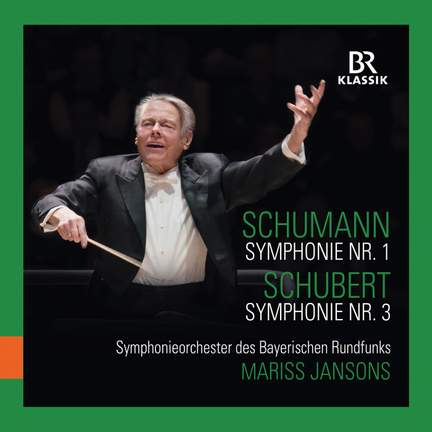
Jansons offers ‘big band’ Schumann, in a performance of the Spring that demonstrates that a long-established symphony orchestra can take on the new boys and girls…Jansons’s sap is clearly rising…There’s...
Schumann: Symphony No. 1 & Schubert: Symphony No. 3
Symphonieorchester des Bayerischen Rundfunks, Mariss Jansons
Purchase product
Jansons offers ‘big band’ Schumann, in a performance of the Spring that demonstrates that a long-established symphony orchestra can take on the new boys and girls…Jansons’s sap is clearly rising…There’s...
About
The two orchestral works on this new CD from BR-KLASSIK reflect early experiments with the symphonic genre by Franz Schubert and Robert Schumann, who would both later become such important Romantic composers. In his Third Symphony in D major, D. 200, written in the early summer of 1815 and probably first performed at a private concert, the eighteen-year-old Schubert emancipated himself from the style copies of his First and Second Symphonies and finally found his own musical expression. None of his symphonies would be heard in public during his lifetime, however; the Third was first performed as late as 1881 in London, where it was immediately received with great enthusiasm. Schumann's First Symphony in B flat major, op 38 (after an unfinished symphony he wrote in his youth) was an impressive success for the 31-year-old composer. Two months after its completion, in January 1841, the work was premiered by Felix Mendelssohn at the Leipzig Gewandhaus to great public acclaim.
Contents and tracklist
Awards and reviews
 July 2019
Jansons offers ‘big band’ Schumann, in a performance of the Spring that demonstrates that a long-established symphony orchestra can take on the new boys and girls…Jansons’s sap is clearly rising…There’s a great deal of subtlety, too, in the phrase-shaping, with woodwind especially exhibiting bags of character and freedom.