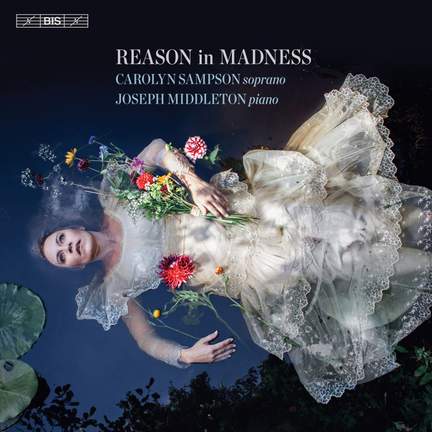
Reason in Madness
Carolyn Sampson (soprano) & Joseph Middleton (piano)
Awards:
-
Presto Editor's Choice, April 2019

Much of this repertory suits Sampson wonderfully well. Her silvery tone suggests fragility from the outset, while her restrained way with words admirably conveys the vagaries of desire, distress...
Reason in Madness
Carolyn Sampson (soprano) & Joseph Middleton (piano)
Purchase product
Awards:
-
Presto Editor's Choice, April 2019
Much of this repertory suits Sampson wonderfully well. Her silvery tone suggests fragility from the outset, while her restrained way with words admirably conveys the vagaries of desire, distress...
About
Throughout history men have feared madwomen, burning them as witches, confining them in asylums and subjecting them to psychoanalysis – yet, they have also been fascinated, unable to resist fantasizing about them. For their new disc, Carolyn Sampson and Joseph Middleton have created a programme that explores the responses of a variety of composers to women whose stories have left them vulnerable and exposed. As a motto they have chosen an aphorism by Nietzsche: ‘There is always some madness in love, but there is also always some reason in madness'. Brahms’ Ophelia Songs, composed for a stage production of Hamlet, appear next to those by Richard Strauss and Chausson, while Ophelia's death is described by both Schumann (in Herzeleid) and Saint-Saëns. Goethe’s mysterious and traumatized Mignon appears in settings by Hugo Wolf as well as Duparc, while his ill-used Gretchen grieves by her spinning-wheel in Schubert's matchless setting. Sampson and Middleton end their recital as it began, with a suicide by drowning: in Poulenc’s monologue La Dame de Monte-Carlo, the elderly female protagonist has been unlucky at the gambling tables and decides to throw herself into the sea.
Contents and tracklist
Spotlight on this release
-
Carolyn Sampson on Reason in Madness
15th Apr 2019
The soprano talks to Katherine about her Nietzsche-inspired recital of songs depicting vulnerable women by Debussy, Koechlin, Poulenc, Schumann and others, out now on BIS.

Awards and reviews
-
Presto Editor's ChoiceApril 2019
 June 2019
Much of this repertory suits Sampson wonderfully well. Her silvery tone suggests fragility from the outset, while her restrained way with words admirably conveys the vagaries of desire, distress and confusion…The disc owes its success as much to Middleton as to Sampson. His playing is beautifully subtle and accomplished, and you get a real sense of singer and accompanist thinking and feeling alike throughout.
 April 2019
Sampson’s fresh, vernal soprano and Middleton’s warmly empathetic pianism convey all the complexities of the vulnerable women depicted here...Brahms’s unaccompanied setting of ‘They bore him barefaced on the bier’ makes for an unsettling, hypnotic opening track, and though Sampson does youthful fragility supremely well she’s equally affecting as the raddled femme d'un certain age in Poulenc’s La Dame de Monte Carlo.
 4th April 2019
All performed with Sampson’s wonted freshness of tone, superb control and subtle sensuality, with Middleton offering vibrant support.