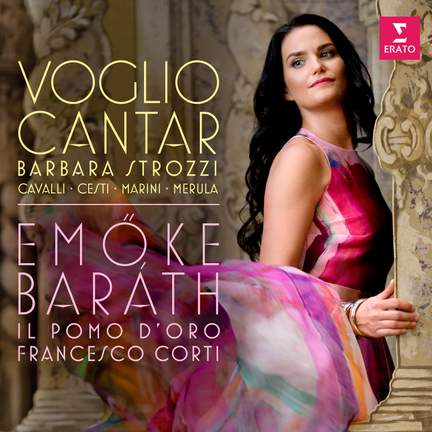
Special offer. Voglio cantar
Strozzi, Cavalli, Cesti, Marini, Merula
Emöke Baráth (soprano), Il Pomo d'Oro, Francesco Corti
Awards:
-
Opus Klassik Awards, 2019, Winner - Newcomer (singer)

-
International Opera Awards, 2020, Nominated - Solo Recital Recording

With extrovert support from Il Pomo d’Oro and harpsichordist-director Francesco Corti, each song becomes a vocal and dramatic showcase, emphasising abrupt switches between extreme psychologist...
Special offer. Voglio cantar
Strozzi, Cavalli, Cesti, Marini, Merula
Emöke Baráth (soprano), Il Pomo d'Oro, Francesco Corti
Purchase product
Awards:
-
Opus Klassik Awards, 2019, Winner - Newcomer (singer)
-
International Opera Awards, 2020, Nominated - Solo Recital Recording
With extrovert support from Il Pomo d’Oro and harpsichordist-director Francesco Corti, each song becomes a vocal and dramatic showcase, emphasising abrupt switches between extreme psychologist...
About
Voglio cantar – ‘I want to sing’ – is Emőke Baráth’s first solo album for Erato. The young Hungarian soprano has built a special reputation in Baroque music and the prime focus here is on Barbara Strozzi, who made her name as a composer in 17th century Venice. “She must have been quite a revolutionary personality,” says Emőke Baráth. “Her music is improvisational, intuitive, even rhapsodic … She was clearly a passionate woman with a strong dramatic sense.” Baráth is joined by Il Pomo d’Oro, conducted by Francesco Corti.
Contents and tracklist
Spotlight on this release
-
An error occurred.
Try watching this video on www.youtube.com, or enable JavaScript if it is disabled in your browser.
Awards and reviews
-
Opus Klassik Awards2019Winner - Newcomer (singer)
-
International Opera Awards2020Nominated - Solo Recital Recording
 April 2019
With extrovert support from Il Pomo d’Oro and harpsichordist-director Francesco Corti, each song becomes a vocal and dramatic showcase, emphasising abrupt switches between extreme psychologist states…If Baráth’s richly operatic delivery feels sometimes counterintuitive in Strozzi’s more intimate laments, it’s nonetheless a reminder that Cavalli and Cesti in particular found fame in that spectacular new stage genre.
 March 2019
The affecting falling intervals of her dark laments strike to the heart like a knife, and when there is playfulness it can still work to a serious and wholly appropriate end…Baráth’s voice is strong, bright and clear, innately attractive with crisply enunciated words…The expert contributions from Il Pomo d’Oro, including short instrumental interludes by Marini and Merula, are typically tight and pingy.
 June 2019
Not only is the voice intrinsically lovely, but Baráth brings a range of colour and nuance that show a grasp of both textual (so important in this repertoire) and musical syntax…by any standards this is exceptionally compelling singing and the singer is given outstandingly stylish support by members of Il Pomo d’Oro.
 24th February 2019
Baráth’s rich and expressive palette entrances in this neglected music.
Opera Now February 2019
The Hungarian singer sustains the high tessitura with ease, and is engaged and stylish in her performances of this generally neglected music, and uses an unusual ‘shake’ to lead into some phrases, best described as an inverted trill. Francesco Corti’s conducting is balanced, and he works in great partnership with his soloist.