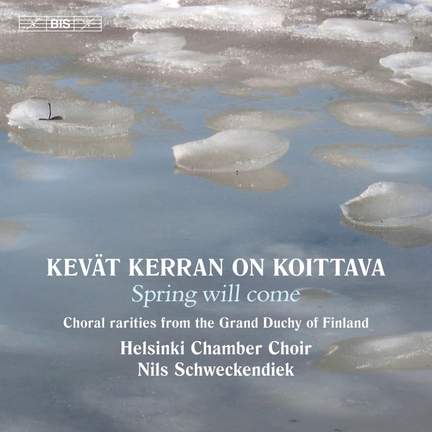
Spring Will Come
Choral rarities from the Grand Duchy of Finland
David Hackston (tenor), Jukka Jokitalo (tenor), Juha-Pekka Mitjonen (bass), Jussi Linnanmäki (bass), Meri Metsomäki (soprano), Iris Roost (alto), Viivi Tulkki (alto), Jussi Salonen (tenor), Júlia Heéger (soprano), Helsinki Chamber Choir, Nils Schweckendiek
These are also mostly miniatures, only one of them over the three minute mark and most under two, as sweet-sour and unexpected as a cloudberry eaten in the field. Obscure the provenances (some...
Spring Will Come
Choral rarities from the Grand Duchy of Finland
David Hackston (tenor), Jukka Jokitalo (tenor), Juha-Pekka Mitjonen (bass), Jussi Linnanmäki (bass), Meri Metsomäki (soprano), Iris Roost (alto), Viivi Tulkki (alto), Jussi Salonen (tenor), Júlia Heéger (soprano), Helsinki Chamber Choir, Nils Schweckendiek
Purchase product
These are also mostly miniatures, only one of them over the three minute mark and most under two, as sweet-sour and unexpected as a cloudberry eaten in the field. Obscure the provenances (some...
About
From a 21st-century perspective, Sibelius may appear to stand more or less alone in the history of Finnish music. It is easy to forget that he could not have fulfilled his artistic potential if his environment had not been conducive to musical creativity. But much of the music that was part of that environment has been almost completely forgotten, often because its aesthetic didn’t accord with the prevailing nationalist trends of the late 19th century.
In this programme of choral works, Nils Schweckendiek and his Helsinki Chamber Choir guide us through some 80 years of Finnish music for choir, from the period when the country formed part of the Russian Empire, as the Grand Duchy of Finland. It was during this time that a Finnish nationalist movement began to take form, in opposition towards the political and cultural dominance of Russia and Sweden respectively. This development can be traced in the way the idea of Spring – a staple in the songs of the Nordic countries – changes from a sense of joy at the end to the hardships of winter to a metaphor for liberation from political oppression. Another result was the Fennicizationtowards the end of the 19th century, during which many popular Swedish and German-language songs were translated into Finnish and the originals in effect suppressed – a case in point being the earliest piece on the disc, F. A. Ehrström’s Svanen (The Swan, 1833), which has had its original Swedish text restored for this recording.
Contents and tracklist
- Helsinki Chamber Choir
- Nils Schweckendiek
- Helsinki Chamber Choir
- Nils Schweckendiek
- Helsinki Chamber Choir
- Nils Schweckendiek
- Helsinki Chamber Choir
- Nils Schweckendiek
- Helsinki Chamber Choir
- Nils Schweckendiek
- David Hackston (tenor), Jukka Jokitalo (tenor), Juha-Pekka Mitjonen (bass), Jussi Linnanmäki (bass)
- Nils Schweckendiek
- David Hackston (tenor)
- Helsinki Chamber Choir
- Nils Schweckendiek
- Helsinki Chamber Choir
- Nils Schweckendiek
- Helsinki Chamber Choir
- Nils Schweckendiek
- Helsinki Chamber Choir
- Nils Schweckendiek
- Helsinki Chamber Choir
- Nils Schweckendiek
- Meri Metsomäki (soprano), Iris Roost (alto)
- Helsinki Chamber Choir
- Nils Schweckendiek
- Helsinki Chamber Choir
- Nils Schweckendiek
- Viivi Tulkki (alto)
- Helsinki Chamber Choir
- Nils Schweckendiek
- Helsinki Chamber Choir
- Nils Schweckendiek
Awards and reviews
 March 2019
These are also mostly miniatures, only one of them over the three minute mark and most under two, as sweet-sour and unexpected as a cloudberry eaten in the field. Obscure the provenances (some of them) may be, but this is a recording that bursts with charm, and perfectly pitched at under an hour.
 January 2019
On one level, we sense what a radical and refreshing voice Sibelius’s must have been. On another, we hear technically secure composers with strong instincts and, occasionally, the green shoots of a distinctive national voice…Perhaps the most distinctive voice is that of Armas Järnefelt…Among a great deal of middle-of-the-road 19th-century fare, his ‘The Path oft eh Beloved’ stands out from its opening chord.
 February 2019
Marvellous performances of an interesting survey of Finnish choral music.