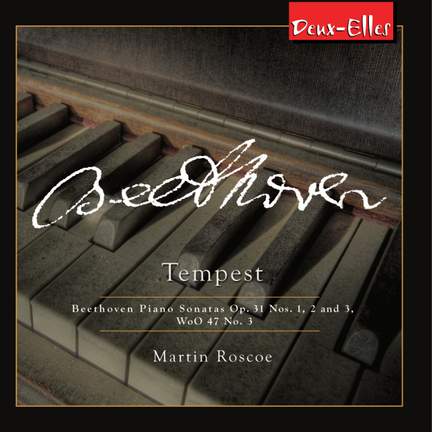
Beethoven Piano Sonatas Volume 7: Tempest
Martin Roscoe (piano)
The Tempest Sonata starts well, with its Allegro smooth, rapid, and menacing, but the Adagio, which should be mysterious and even oracular, emerges in routine conversational mode…But with the...
Beethoven Piano Sonatas Volume 7: Tempest
Martin Roscoe (piano)
Purchase product
The Tempest Sonata starts well, with its Allegro smooth, rapid, and menacing, but the Adagio, which should be mysterious and even oracular, emerges in routine conversational mode…But with the...
About
The main part of this volume is devoted to the Op 31 Sonatas composed in 1802 at a time when Beethoven was probably in the darkest place of his whole life, early in his thirties with the realisation of his impending deafness. In October the same year, Beethoven wrote his famous Heiligenstadt Testament, a will in which he left everything to his two brothers and an outpouring of the despair he felt at the realisation that his deafness was only going to get worse.
Martin notes “It’s astonishing that..Beethoven was able to be so prolific as he was at this time, and even more amazing that so many of his works are so full of spirit, energy and humour.” This volume also includes the D major No. 3, composed by Beethoven when was twelve - one of the most sophisticated and technically challenging of the three early WoO47 Sonatas.
Contents and tracklist
Awards and reviews
 February 2019
The Tempest Sonata starts well, with its Allegro smooth, rapid, and menacing, but the Adagio, which should be mysterious and even oracular, emerges in routine conversational mode…But with the wacky Op. 31 No. 3 Roscoe comes up trumps, finding an ideal flexibility for its succession of surprises.
 December 2018
Roscoe charts a steady course through the serious and occasionally threatening terrain of the Tempest Sonata…These are original readings of great style, with and imagination, each sonata emerging with rare emotional and intellectual cohesion. I think you’ll enjoy them.