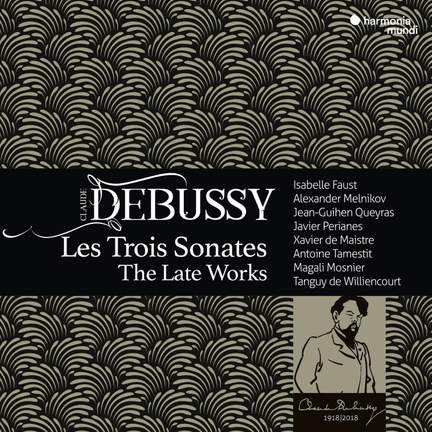
Debussy: Les Trois Sonates, The Late Works
The Three Sonatas
Isabelle Faust (violin), Alexander Melnikov (piano), Tanguy de Williencourt (piano), Magali Mosnier (flute), Antoine Tamestit viola), Xavier de Maistre (harp), Jean-Guihen Queyras (cello), Javier Perianes (piano)
Awards:
-
Gramophone Magazine, November 2018, Editor's Choice

-
Presto Recording of the Week, 16th November 2018

-
Presto Recordings of the Year, Finalist 2018

-
BBC Music Magazine, Christmas 2018, Chamber Choice

-
BBC Music Magazine Awards, 2019, Finalist - Chamber

-
BBC Music Magazine Awards, 2019, Winner - Chamber
-
Gramophone Awards, 2019, Winner - Chamber

-
International Classical Music Awards, 2019, Nominee - Chamber Music

Until recently this music was almost invariably viewed and experienced through a prism of 19th-century rhetoric – listening to Isabelle Faust and Alexander Melnikov deftly tracing the evanescent...
Debussy: Les Trois Sonates, The Late Works
The Three Sonatas
Isabelle Faust (violin), Alexander Melnikov (piano), Tanguy de Williencourt (piano), Magali Mosnier (flute), Antoine Tamestit viola), Xavier de Maistre (harp), Jean-Guihen Queyras (cello), Javier Perianes (piano)
Purchase product
Awards:
-
Gramophone Magazine, November 2018, Editor's Choice
-
Presto Recording of the Week, 16th November 2018
-
Presto Recordings of the Year, Finalist 2018
-
BBC Music Magazine, Christmas 2018, Chamber Choice
-
BBC Music Magazine Awards, 2019, Finalist - Chamber
-
BBC Music Magazine Awards, 2019, Winner - Chamber
-
Gramophone Awards, 2019, Winner - Chamber
-
International Classical Music Awards, 2019, Nominee - Chamber Music
Until recently this music was almost invariably viewed and experienced through a prism of 19th-century rhetoric – listening to Isabelle Faust and Alexander Melnikov deftly tracing the evanescent...
About
A century after his death on 25 March 1918, many harmonia mundi artists are eager to pay tribute to Claude Debussy, the magician of melody and timbre, the great ‘colourist’ and father of modern music.
In the three chamber sonatas, here combined with the composer’s final pieces for solo piano, we attain the purity, the absolute concision, the distant and mysterious world that give these works a testamentary dimension.
Contents and tracklist
Spotlight on this release
-
Late Debussy sonatas from Isabelle Faust, Alexander Melnikov and friends
16th Nov 2018
Harmonia Mundi's ten-album series commemorating the centenary of Debussy's death continues with the Violin Sonata, Cello Sonata, and Sonata for Flute, Viola and Harp.

Awards and reviews
-
Gramophone MagazineNovember 2018Editor's Choice
-
Presto Recording of the Week16th November 2018
-
Presto Recordings of the YearFinalist 2018
-
BBC Music MagazineChristmas 2018Chamber Choice
-
International Classical Music Awards2019Nominee - Chamber Music
 Christmas 2018
Until recently this music was almost invariably viewed and experienced through a prism of 19th-century rhetoric – listening to Isabelle Faust and Alexander Melnikov deftly tracing the evanescent contours of the Violin Sonata comes therefore as something of a revelation…Most striking of all is the enchanting triple sonata, whose harp-inflected musings appear to float free of musical gravity in this hypnotic account…One of the most captivating releases of the Debussy centenary year.
 November 2018
Isabelle Faust and Alexander Melnikov’s account of the Violin Sonata, Debussy’s last completed score, embraces exquisite fragility and strength in equal measure...Jean-Guihen Queyras and Javier Perianes’s performance of the Cello Sonata, noble in manner and grand in scale, balances the austere grief of the opening movement with understated wit in the Sérénade...Listen to it in a single sitting, and in the right playing order: it’s extraordinarily moving.
Classical Music November 2018
Isabelle Faust is a superb, sinewy soloist for the Violin Sonata, with Melnikov a strong partner. The Sonata for flute, viola and harp is gorgeous, so ephemeral it seems hardly there. The energy of the finale is all present and correct, but again so elusive. This is, surely, a definitive performance; the recording is perfectly judged. Williencourt plays the sombre Elegie superbly; Perianes provides a different, more assertive piano sound for the Cello Sonata. Queyras’ control in this piece is definitive, as is his eloquence.