Special offer. Tchaikovsky & Juon: Piano Trios
Boulanger Trio
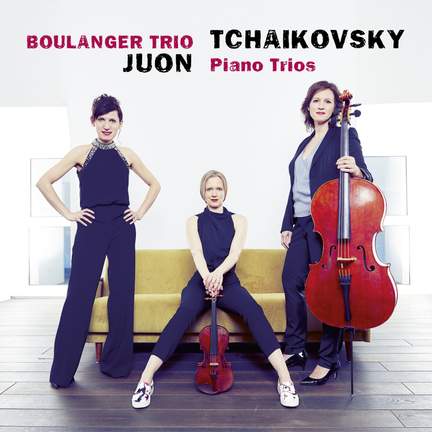
Special offer. Tchaikovsky & Juon: Piano Trios
Boulanger Trio
Purchase product
About
“In Juon’s piano trio”, as the members of the Boulanger Trio find, “we plunge into the most profound recesses of the soul. Everything acquires existential significance. This work truly captivates us: so much occurs within such brief moments”. This is where our performers find a bridge that connects Juon’s kaleidoscopic tone poem with PETER TCHAIKOVSKY’s colossal Piano Trio, op. 50, a musical epitaph for pianist and conductor Nikolai Rubinstein, who had been Tchaikovsky’s friend and mentor.
Rubinstein had ensured that the young Tchaikovsky was allowed to enter the newly founded Moscow Conservatory while taking him up as a resident in his own home. “He looked after my every need like a child’s nurse”, Tchaikovsky wrote to his family in Saint Petersburg. Rubinstein not only made sure
that Tchaikovsky wore appropriately elegant clothing, but he took him to the opera and to concerts while introducing him to his circle of colleagues and friends, playing out his connections to draw their attention to his protégé’s compositions.
His unexpected passing in 1881, when he was only 45, must have profoundly shattered the young Tchaikovsky, who dedicated the only piano trio he ever
wrote to his late friend, adding the subtitle À la mémoire d’un grand artiste.
The work consists of only two monumental, thematically related movements. Beginning with a heartfelt cello cantilena, the first one is an extensive elegy or Pezzo elegiaco: an immense variety of musical ideas flow together in this sonata form with exposition, development, and reprise. The second movement consists in a seemingly endless set of variations. According to his friend Nikolai Kashkin, Tchaikovsky wanted to “paint a musical portrait of Rubinstein in different phases of his life”.
Whether that be true or not, this is indeed a musical broadsheet of illustrated character variations. Particular mention can be made of the third variation, a brilliant piano caprice, the fifth, where the piano imitates bell chimes, the sixth in form of a waltz, and the elaborate fugue in the eighth. The twelfth variation-cum-finale sets in powerfully and energetically, but harks back to the first movement by concluding with a poignant funeral march.
Chief Vienna music critic Eduard Hanslick found that Tchaikovsky’s trio, despite “a number of original traits and successful turns of phrase”, belonged to the kind of “quasi-suicidal compositions that destroy their own effect because of their merciless length”. Today, however, it is regarded as one of
the milestones in the genre of chamber music with piano.
Contents and tracklist
- Boulanger Trio
- Boulanger Trio