From the Early 20th
Andrew Rangell (piano)
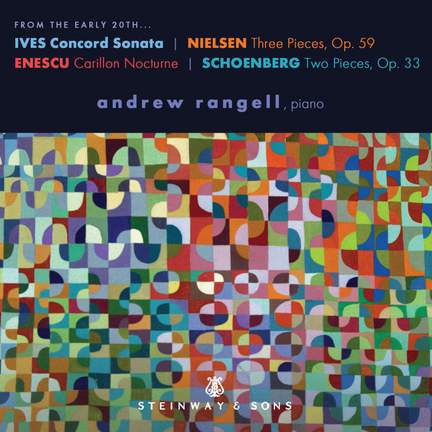
For the Ives, Rangell again accentuates the lyrical side, taking the edge offsome of the mania. While both Aimard and Hamelin are if anything too assured, Rangell offers a different contextualisation....
From the Early 20th
Andrew Rangell (piano)
Purchase product
For the Ives, Rangell again accentuates the lyrical side, taking the edge offsome of the mania. While both Aimard and Hamelin are if anything too assured, Rangell offers a different contextualisation....
About
Andrew Rangell writes: “Charles Ives’ Concord Sonata, whose monumental cussedness, tenderness, and imaginative daring epitomize the character and gifts of its Yankee creator, emerged, not easily, into the world one century ago. Ives’ final work for piano, it contains multitudes. To adorn this centerpiece, Andrew Rangell has chosen the final, and stellar, piano pieces of Arnold Schoenberg and Carl Nielsen, European contemporaries who (like Ives) spoke their minds… Lastly, Enescu’s Carillon Nocturne, written at the same time as Ives’ sonata, is for me a mystical parallel to the Concord meditation called Thoreau.” Long recognized as among our most eloquent and insightful interpreters of the major keyboard works of Bach and Beethoven, pianist Andrew Rangell has drawn acclaim for a variety of recordings. The present recording (Mr. Rangell’s 30th) can be considered a counterpart, and complement, to his 2009 Bridge recording of Ives’ First Piano Sonata, Nielsen’s Op. 45 Suite, and John McDonald’s Meditation Before a Sonata, a beautiful homage to Ives’ Concord.
Contents and tracklist
- Andrew Rangell (piano)
- Recorded: 26-27 December 2017 and 2 February 2018
- Recording Venue: Shalin Liu Performance Center, Rockport, Massachusetts
- Andrew Rangell (piano)
- Recorded: 26-27 December 2017 and 2 February 2018
- Recording Venue: Shalin Liu Performance Center, Rockport, Massachusetts
Awards and reviews
 November 2018
For the Ives, Rangell again accentuates the lyrical side, taking the edge offsome of the mania. While both Aimard and Hamelin are if anything too assured, Rangell offers a different contextualisation. Fascinating listening.