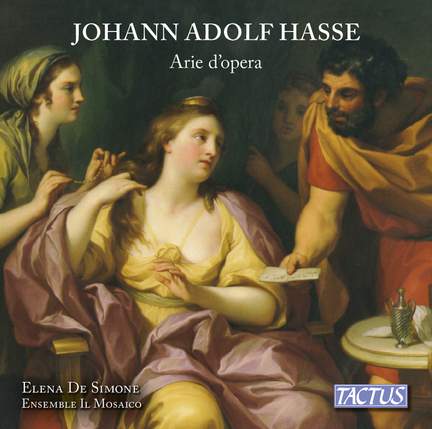
Special offer. Hasse: Arie D'opera
Elena De Simone (mezzo)
Ensemble Il Mosaico
Throughout the CD De Simone proves herself happier with Hasse’s innate lyricism, but her technique is at times confusing, incorporating strong yet at the same time breathily tentative chest...
Special offer. Hasse: Arie D'opera
Elena De Simone (mezzo)
Ensemble Il Mosaico
Purchase product
Throughout the CD De Simone proves herself happier with Hasse’s innate lyricism, but her technique is at times confusing, incorporating strong yet at the same time breathily tentative chest...
About
The German composer Johann Adolf Hasse was born in Bergedorf on 25 March 1699 and died in Venice on 23 December 1783. He chose Italy as his adopted country: there he was nicknamed 'the dear Saxon'. He was a pupil of Nicola Porpora and Alessandro Scarlatti, from whom he learned the typical composition style of the Neapolitan School. In 1727 he was appointed Kapellmeister of the Conservatorio degli Incurabili of Venice, city in which he met his bride, Faustina Bordoni. He was engaged as a composer by the Polish court, for which he composed a great number of operas that were staged in Dresden and in other European countries, particularly Italy. The arias presented here by Elena De Simone belong to the genre of the opera seria and have been chosen among the most representative ones in Hasse’s unpublished production, which is based on texts – most of them by Metastasio and Apostolo Zeno – that were a great source of inspiration for the major European musicians of that time.
Contents and tracklist
- Elena de Simone (mezzo-soprano)
- Ensemble Il Mosaico
- Elena de Simone (mezzo-soprano)
- Ensemble Il Mosaico
- Elena de Simone (mezzo-soprano)
- Ensemble Il Mosaico
- Elena de Simone (mezzo-soprano)
- Ensemble Il Mosaico
- Elena de Simone (mezzo-soprano)
- Ensemble Il Mosaico
- Elena de Simone (mezzo-soprano)
- Ensemble Il Mosaico
- Elena de Simone (mezzo-soprano)
- Ensemble Il Mosaico
- Elena de Simone (mezzo-soprano)
- Ensemble Il Mosaico
Awards and reviews
 November 2018
Throughout the CD De Simone proves herself happier with Hasse’s innate lyricism, but her technique is at times confusing, incorporating strong yet at the same time breathily tentative chest notes, good passagework and nicely turned ornaments (including a shallow trill), yet a distinct reluctance to fill out cadences. Nonetheless, there is unquestionably an underlying musicality and empathy with the music.