Rachmaninov: Vespers
Agnieszka Rehlis (mezzo-soprano), Rafał Bartmiński (tenor), Krzysztof Drugow (bass)
Choir of The Podlasie Opera and Philharmonic, Violetta Bielecka
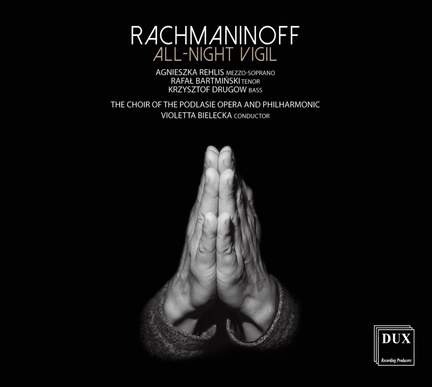
Rachmaninov’s work was first performed to help the Russian war effort in 1915 and it has an intriguingly bracing air in this new interpretation, which won’t be to every taste but which scores...
Rachmaninov: Vespers
Agnieszka Rehlis (mezzo-soprano), Rafał Bartmiński (tenor), Krzysztof Drugow (bass)
Choir of The Podlasie Opera and Philharmonic, Violetta Bielecka
Purchase product
Rachmaninov’s work was first performed to help the Russian war effort in 1915 and it has an intriguingly bracing air in this new interpretation, which won’t be to every taste but which scores...
About
Vespers – a cycle of religious services celebrated by the followers of the Orthodox Church on the eve of all feasts and each Little Pascha - i.e. Sunday. Vechernya, povecherye and utrenya are celebrated from evening to dawn. Among numerous composers who have developed the text of Vespers, it is Sergey Rachmaninoff that stands out due to the mastery of form. Carefully selected sounds of discreetly modern harmony render the acoustics of an Eastern Orthodox temple. Changes of cast (from three to eleven voices) and polychorality depict a sui generis theatrical nature of Orthodox church ceremonies whose action evolves on a few levels, in different space points of the temple. It is particularly the sonorous, crystalline registers of female voices that contrast and perfectly combine with the male voices, among which the basso profondo basses, rarely found in the Western culture, have a profound meaning. The Podlasie Opera and Philharmonic Choir, also due to its artistic level, guarantees the highest performance level of this kind of music in Poland.
Contents and tracklist
- Agnieszka Rehlis (mezzo-soprano), Rafał Bartmiński (tenor), Krzysztof Drugow (bass)
- Podlasie Opera and Philharmonic Choir, Podlasie Opera and Philharmonic Symphony Orchestra
- Violetta Bielecka
- Recorded: 4–8 May 2017
- Recording Venue: Podlasie Opera and Philharmonic, European Art Centre, Białystok, Poland
Awards and reviews
 March 2019
Rachmaninov’s work was first performed to help the Russian war effort in 1915 and it has an intriguingly bracing air in this new interpretation, which won’t be to every taste but which scores high for bright, accurate singing (full marks to the soloists) and sympathetic accompaniment.
 July 2018
The dramatic momentum never lets up, and this is an extremely important element in any performance of this work: it is all too easy to emphasise the importance of individual sections at the expense of the sense of the whole, and this Bielecka and her singers are careful never to do.