Commedia! Commedia!
Accademia Strumentale Italiana
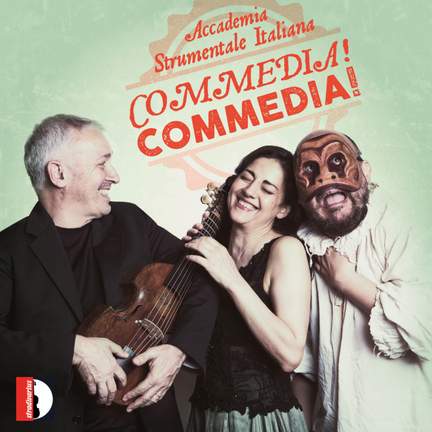
Commedia! Commedia!
Accademia Strumentale Italiana
Purchase product
About
The pieces on this recording have in common the idea that they can be possibly used in the context of comedy, beginning with the series of dances inevitably present in every form of performance, from improvised theatre with comic actors to courtly intermediate genres, the comedieballet in France and the English masque. Besides these, the following are clearly for the stage : "Ben staga", "Chi passa per ‘sta strada" (already mentioned), the allusive "Vorrei che tu cantasse una canzone" by Filippo Azzaiolo (Primo libro delle villotte alla padoana […] dette villotte del fiore, 1557), the no less risque "Il estoit une fillette" by Clement Janequin (from Huitiesme livre contenant XIX chansons nouvelles a quatre parties, 1540: to have it performed by an actor is another precise reference to a consistent practice in comedy). There is also Vecchie letrose by Willaert (Canzone villanesche alla napolitana, 1545); and Matona mia cara by Orlando di Lasso, with its caricature of the German language (Libro de Villanelle, Moresche, et altre Canzoni, 1581), one of many examples in which music aids comedy, amplifies through polyphony its favourite word play and mixtures of language, and indulges its extravagant inspiration. Sometimes the madrigal, too, is attracted into the comic orbit, as in the case of Ancor ch’al parturire by the Modena composer Orazio Vecchi (from L’amfiparnaso, 1594), which parodies the renowned madrigal Ancor che col partire by Cipriano Rore (1547). Inserted simply a l’improvisa for voice and lute, expressed in the most elaborate polyphonic forms or in dance scenes, music is an essential complement of comedy as a simultaneous translation of words and gestures into the strong substance of sounds. After all, only the iniquitous soul can resist the seduction of music. It was William Shakespeare who wrote this, in the Merchant of Venice (Act V, Scene 1, 83-85) and the thought is inspired by a just-concluded musical performance on the stage: "The man that hath no music in himself, nor is not mov'd with concord of sweet sounds, is fit for treason, stratagems and spoils". Accademia Strumentale Italiana ALBERTO RASI Elena Bertuzzi, soprano Luigi Lupo, flauti Davide Monti, violino Claudia Pasetto, viola da gamba tenore Beatrice Pornon, liuto e chitarra Alberto Rasi, viola da gamba bassa Sbibu, percussioni * con la partecipazione di Lorenzo Bassotto, commediante
Contents and tracklist
- Alberto Rasi (viola da gamba)
- Accademia Strumentale Italiana
- Recorded: February 2017
- Elena Bertuzzi (soprano), Lorenzo Bassotto (vocals), Alberto Rasi (viola da gamba)
- Accademia Strumentale Italiana
- Recorded: February 2017
- Alberto Rasi (viola da gamba)
- Accademia Strumentale Italiana
- Recorded: February 2017
- Elena Bertuzzi (soprano), Alberto Rasi (viola da gamba)
- Accademia Strumentale Italiana
- Recorded: February 2017
- Alberto Rasi (viola da gamba)
- Accademia Strumentale Italiana
- Recorded: February 2017
- Elena Bertuzzi (soprano), Alberto Rasi (viola da gamba)
- Accademia Strumentale Italiana
- Recorded: February 2017
- Alberto Rasi (viola da gamba)
- Accademia Strumentale Italiana
- Recorded: February 2017
- Elena Bertuzzi (soprano), Alberto Rasi (viola da gamba)
- Accademia Strumentale Italiana
- Recorded: February 2017
- Alberto Rasi (viola da gamba)
- Accademia Strumentale Italiana
- Recorded: February 2017
- Elena Bertuzzi (soprano), Alberto Rasi (viola da gamba)
- Accademia Strumentale Italiana
- Recorded: February 2017
- Alberto Rasi (viola da gamba)
- Accademia Strumentale Italiana
- Recorded: February 2017
- Elena Bertuzzi (soprano), Alberto Rasi (viola da gamba)
- Accademia Strumentale Italiana
- Recorded: February 2017
- Alberto Rasi (viola da gamba)
- Recorded: February 2017
- Alberto Rasi (viola da gamba)
- Accademia Strumentale Italiana
- Recorded: February 2017
- Elena Bertuzzi (soprano), Alberto Rasi (viola da gamba)
- Accademia Strumentale Italiana
- Recorded: February 2017