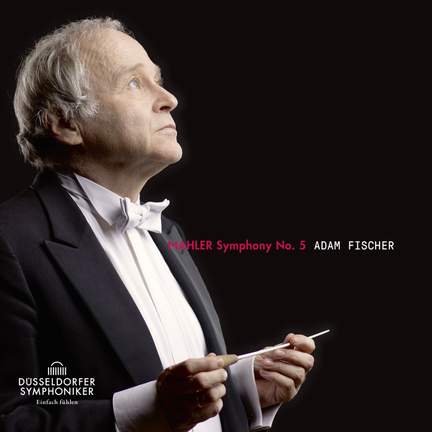
Mahler: Symphony No. 5
Ádám Fischer and Düsseldorfer Symphoniker
Awards:
-
Gramophone Magazine, July 2018, Editor's Choice

Fischer’s elastic sense of tempo can be stretched to extremes in the Adagietto…What remains outstanding is the textural clarity…and among the clearest renderings on disc of the finale’s teeming...
Mahler: Symphony No. 5
Ádám Fischer and Düsseldorfer Symphoniker
Purchase product
Awards:
-
Gramophone Magazine, July 2018, Editor's Choice
Fischer’s elastic sense of tempo can be stretched to extremes in the Adagietto…What remains outstanding is the textural clarity…and among the clearest renderings on disc of the finale’s teeming...
About
The fourth release in the critically acclaimed Mahler Symphony cycle by Adam Fischer and the Düsseldorfer Symphoniker.
"Unlike certain other Mahler symphonies, I have no personal story I associate with the Fifth. This doesn't imply that it is not just as close to me as the other ones; it is just more difficult to express the connection in words. In 1905, Mahler recorded his own interpretation of this symphony's first movement on a Welte-Mignon piano roll. We should try to grasp Mahler's intentions, but we should not apply them without using our own discretion. The Welte-Mignon recording is an important document to help us learn how to deal with Mahler's tempo indications. There are those well-known indications of the length of his own orchestral performances: they show, for instance, that the Adagietto, in particular, should be played much more rapidly than we think. Incredibly fast runtimes were clocked in Saint Petersburg and also at the Concertgebouw: when we compare them with the movement runtimes as performed by famous conductors of the 1950s and 1960s, we can tell that "slow", for Mahler, does not mean "dragging". Most of all - this is my fundamental conviction, and here I find it confirmed - slow and fast aren't just metronome values. You can play faster while sounding slower, and vice-versa. It does not just have to do with maintaining a slow tempo, but with managing the accents so that it also sounds slower. Sounding slower is more important than merely being slower. You can hear this in the Welte-Mignon recording: Mahler treats his own music in a thoroughly rhapsodic way." Adam Fischer
Contents and tracklist
Awards and reviews
-
Gramophone MagazineJuly 2018Editor's Choice
 August 2018
Fischer’s elastic sense of tempo can be stretched to extremes in the Adagietto…What remains outstanding is the textural clarity…and among the clearest renderings on disc of the finale’s teeming fugues…A peerless trumpet rides the first-movement welters impressively, too. The strings may not be the weightiest in the business, but every phrase is beautifully detailed and projected.
 July 2018
Adam Fischer’s kinship with this music seems to grow exponentially with each successive instalment of what is already proving an exceptional Mahler cycle. There’s a stylistic and emotional understanding which goes beyond the precisely annotated scores...Perhaps the most impressive thing about this account of the Fifth Symphony is the ‘in the moment’ feeling it engenders from first to last.