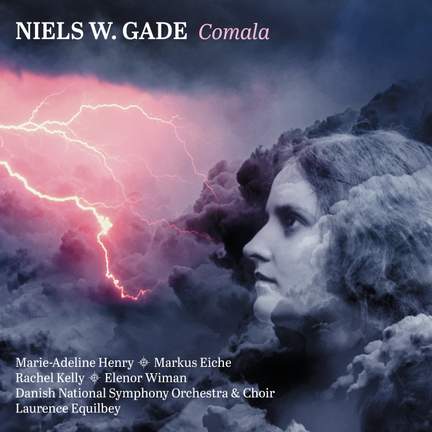
Gade, N: Comala
Marie-Adeline Henry (soprano), Markus Eiche (baritone), Rachel Kelly (mezzo)
Elenor Wiman (alto)
Danish National Symphony Orchestra & Choir, Laurence Equilbey
Stylistically it owes much to Mendelssohn…Marie-Adeline Henry and Markus Eiche, taking on the roles of Comala and Fingal respectively, deliver committed and expressive singing, and conductor...
Gade, N: Comala
Marie-Adeline Henry (soprano), Markus Eiche (baritone), Rachel Kelly (mezzo)
Elenor Wiman (alto)
Danish National Symphony Orchestra & Choir, Laurence Equilbey
Purchase product
Stylistically it owes much to Mendelssohn…Marie-Adeline Henry and Markus Eiche, taking on the roles of Comala and Fingal respectively, deliver committed and expressive singing, and conductor...
About
In 1840s Leipzig the young Danish composer Niels W. Gade (1817-90) was welcomed with open arms, and became Mendelssohn's successor with the Gewandhaus Orchestra. There Gade himself conducted the first performance of his cantata Comala, which travelled as far afield as the USA and Russia. Comala is a lyrical-heroic legend based on James Macpherson's famous Ossian poems about the warrior Fingal and his beloved Comala, here performed by the Danish National Symphony Orchestra & Choir and an inspired team of international soloists under the renowned French conductor Laurence Equilbey.
Contents and tracklist
- Marie-Adeline Henry (soprano), Markus Eiche (baritone), Rachel Kelly (mezzo-soprano), Elenor Wiman (alto)
- Danish National Symphony Orchestra, Danish National Concert Choir
- Laurence Equilbey
- Recorded: 23-24 February 2017
- Recording Venue: Concert Hall, DR Koncerthuset
Awards and reviews
 July 2018
Stylistically it owes much to Mendelssohn…Marie-Adeline Henry and Markus Eiche, taking on the roles of Comala and Fingal respectively, deliver committed and expressive singing, and conductor Laurence Equilbey negotiates the ebb and flow of the drama very effectively with the help of responsive playing from the Danish National Symphony Orchestra.
 July 2018
Based on Ossian (more specifically on Gade’s own op.1 Echoes of Ossian), and inspired by the then (1846) current vogue for the Scottish Highlands, it is a secular cantata that very cleverly contrasts dramatic passages with more lyrical work. It is strange that it should have been criticised for monotony in the German press. It seems on the contrary almost too eager to vary pace and tone, and it is to the credit of the soloists and choir that this doesn’t become excessive. Comala’s fame has perhaps ebbed in recent years. This marvellous recording brings it into fresh focus.