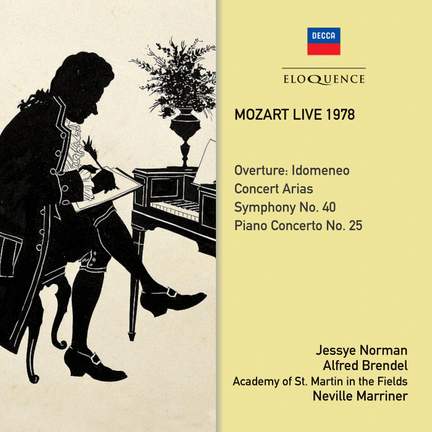
Special offer. Mozart Live 1978
Jessye Norman (soprano), Hugh Maguire (violin), Alfred Brendel (piano)
Academy of St. Martin in the Fields, Neville Marriner
Awards:
-
Gramophone Magazine, September 2018, Reissue/Archive of the Month

With Jessye Norman somewhere near her vocal and theatrical best [in Non temer], and lovely solo playing from Hugh Maguire, Marriner’s former colleague and leader at the LSO, this is well worth...
Special offer. Mozart Live 1978
Jessye Norman (soprano), Hugh Maguire (violin), Alfred Brendel (piano)
Academy of St. Martin in the Fields, Neville Marriner
Purchase product
Awards:
-
Gramophone Magazine, September 2018, Reissue/Archive of the Month
With Jessye Norman somewhere near her vocal and theatrical best [in Non temer], and lovely solo playing from Hugh Maguire, Marriner’s former colleague and leader at the LSO, this is well worth...
About
A first-time CD release for a gala concert given by the pre-eminent Mozart interpreters of the late analogue era.
On 27 January 1978 fell the 222nd birthday of Mozart, and the auspicious occasion was marked in Strasbourg, at the Palais de la Musicque et des Congrès, by an ingeniously planned program which spanned a decade of the composer’s full maturity. Everyone associated with the concert could boast impeccable Mozartian credentials. Two concert arias – ‘Non più, tutto ascoltai’ and the sublime ‘Ch’io mi scordi di te’ – were sung by Jessye Norman, who at that stage in her illustrious career was still taking on the Mozart soprano roles which had won her acclaim at the Royal Opera. The obbligato soloist in the latter aria was none other than Alfred Brendel, whose credentials as a Mozart pianist need no rehearsal, and he returned in the second half of the concert for the magnificent C major Piano Concerto KV 503 of 1786, which wears the profound good humour of the recently premiered Le nozze di Figaro. The concert was completed by the Overture to Idomeneo and the Symphony No. 40, KV 550, played by the ensemble which more than any other was associated in the minds of record-collectors, in the UK at least, with the music of Mozart: the Academy of St. Martin in the Fields, led with his unfailing sense of style by its founder conductor, Neville Marriner. Producing the concert for a subsequent 2LP release on Philips was Erik Smith, who went on to mastermind the label’s Complete Mozart Edition released in time for the 1991 bicentenary of the composer’s death. Portions of the event have been released on CD before, but never the entire concert, which makes this newly remastered reissue on Eloquence an essential acquisition for all Mozart lovers, enhanced by original sleeve notes and texts and translations of the arias.
‘Jessye Norman sings magnificently, with what appears to be effortless agility and with a particularly beautiful quality in mezza voce, and she is most sympathetically partnered by Hugh Maguire and Alfred Brendel respectively … A striking performance of the G minor symphony: appropriately taut and nervous in the quick movements, and with an almost chamber-musical intimacy and refinement in the Andante. The performance of the C major Concerto could hardly be bettered.’ Gramophone, November 1978
Contents and tracklist
- Academy of St Martin in the Fields
- Sir Neville Marriner
- Recorded: 1978-01-28
- Recording Venue: Palais de la musique et des Congres, Strasbourg
- Jessye Norman (soprano), Hugh Maguire (violin)
- Academy of St Martin in the Fields
- Sir Neville Marriner
- Recorded: 1978-01-28
- Recording Venue: Palais de la musique et des Congres, Strasbourg
- Academy of St Martin in the Fields
- Sir Neville Marriner
- Recorded: 1978-01-28
- Recording Venue: Palais de la musique et des Congres, Strasbourg
- Jessye Norman (soprano), Alfred Brendel (piano)
- Academy of St Martin in the Fields
- Sir Neville Marriner
- Recorded: 1978-01-28
- Recording Venue: Palais de la musique et des Congres, Strasbourg
- Alfred Brendel (piano)
- Academy of St Martin in the Fields
- Sir Neville Marriner
- Recorded: 1978-01-28
- Recording Venue: Palais de la musique et des Congres, Strasbourg
Awards and reviews
-
Gramophone MagazineSeptember 2018Reissue/Archive of the Month
 September 2018
With Jessye Norman somewhere near her vocal and theatrical best [in Non temer], and lovely solo playing from Hugh Maguire, Marriner’s former colleague and leader at the LSO, this is well worth disinterring…The merits of the fine performance of the C major Concerto, with which the concert ends, are well known…The slow movement is especially memorable, profoundly felt.