Kellner: Sacred Cantatas
Anna Kellnhofer (soprano), Christoph Dittmar (counter-tenor), Mirko Ludwig (tenor), Ralf Grobe (bass)
Thuringia Capella, Bernhard Klapprott
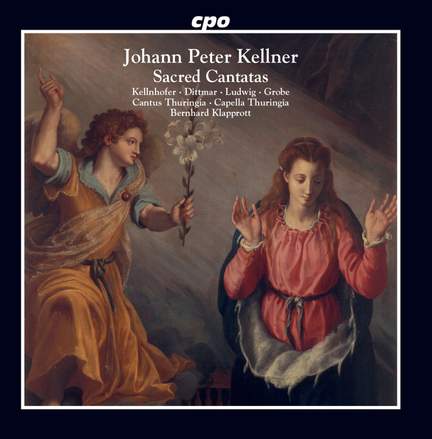
Bernhard Klapprott and his performers breathe fresh life into these delightful cantatas by Johann Peter Kellner celebrating the high points of the liturgical year. The music is given an exemplary...
Kellner: Sacred Cantatas
Anna Kellnhofer (soprano), Christoph Dittmar (counter-tenor), Mirko Ludwig (tenor), Ralf Grobe (bass)
Thuringia Capella, Bernhard Klapprott
Purchase product
Bernhard Klapprott and his performers breathe fresh life into these delightful cantatas by Johann Peter Kellner celebrating the high points of the liturgical year. The music is given an exemplary...
About
Although Johann Peter Kellner received only a relatively brief training in music, he attained a quite considerable compositional level, not least because of his contacts with members of Bach’s circle of friends. Along with the members of the Bach family, this circle included Johann Sebastian Bach’s pupils and musician friends of his such as Jacob Adlung in Erfurt. Until 1762 Johann Peter composed a number of cantatas along with his son Johann Christoph that have been brought together in the Schüler-Jahrgang (Pupil’s Annual Cycle). The organ in a concertizing function occupied a central place in Johann Peter’s cantata oeuvre around 1755 and lends this genre an individual character. This role does not merely involve short inserts of motifs, as was later the case in his son’s cantatas, but an independently concertizing organ heard in alternation with the vocalists and violins and illustrating the text with what in part is a treatment of considerable virtuosity. Influences from Johann Sebastian Bach, Gottfried Heinrich Stölzel, and increasingly Carl Philipp Emanuel Bach were eminent in the composition of Kellner’s cantatas, which are situated in the transitional period of musical styles between the Baroque and the use of empfindsam or galant stylistic means. After some 250 years these cantatas from the generation of Bach’s pupils are now being made available to the broader public on this recording produced in a historical setting with the use of the restored Kellner-Weise organ (1736).
Contents and tracklist
- Anna Kellnhofer (soprano), Christoph Dittmar (alto), Mirko Ludwig (tenor), Ralf Grobe (bass)
- Cantus Thuringia, Capella Thuringia
- Bernhard Klapprott
- Recorded: 27-29 September 2015
- Recording Venue: Church St. Laurentius Gräfenroda, Thuringia, Germany
- Anna Kellnhofer (soprano), Christoph Dittmar (alto), Ralf Grobe (bass), Mirko Ludwig (tenor)
- Cantus Thuringia, Capella Thuringia
- Bernhard Klapprott
- Recorded: 27-29 September 2015
- Recording Venue: Church St. Laurentius Gräfenroda, Thuringia, Germany
- Anna Kellnhofer (soprano), Christoph Dittmar (alto), Mirko Ludwig (tenor), Ralf Grobe (bass)
- Cantus Thuringia, Capella Thuringia
- Bernhard Klapprott
- Recorded: 27-29 September 2015
- Recording Venue: Church St. Laurentius Gräfenroda, Thuringia, Germany
- Anna Kellnhofer (soprano), Christoph Dittmar (alto), Mirko Ludwig (tenor), Ralf Grobe (bass)
- Cantus Thuringia, Capella Thuringia
- Bernhard Klapprott
- Recorded: 27-29 September 2015
- Recording Venue: Church St. Laurentius Gräfenroda, Thuringia, Germany
- Anna Kellnhofer (soprano), Mirko Ludwig (tenor), Ralf Grobe (bass)
- Cantus Thuringia, Capella Thuringia
- Bernhard Klapprott
- Recorded: 27-29 September 2015
- Recording Venue: Church St. Laurentius Gräfenroda, Thuringia, Germany
- Anna Kellnhofer (soprano), Christoph Dittmar (alto), Mirko Ludwig (tenor), Ralf Grobe (bass)
- Cantus Thuringia, Capella Thuringia
- Bernhard Klapprott
- Recorded: 27-29 September 2015
- Recording Venue: Church St. Laurentius Gräfenroda, Thuringia, Germany
- Anna Kellnhofer (soprano), Christoph Dittmar (alto), Mirko Ludwig (tenor), Ralf Grobe (bass)
- Cantus Thuringia, Capella Thuringia
- Bernhard Klapprott
- Recorded: 27-29 September 2015
- Recording Venue: Church St. Laurentius Gräfenroda, Thuringia, Germany
Awards and reviews
 May 2018
Bernhard Klapprott and his performers breathe fresh life into these delightful cantatas by Johann Peter Kellner celebrating the high points of the liturgical year. The music is given an exemplary performance by Cantus Thuringia, the instrumentalists of Capella Thuringia and four superb soloists. Recorded in St Lawrence Church, Gräfenroda, the organ obbligato part in the duets is played by Klapprott on the 1736 Kellner-Weise organ. Highly recommended.