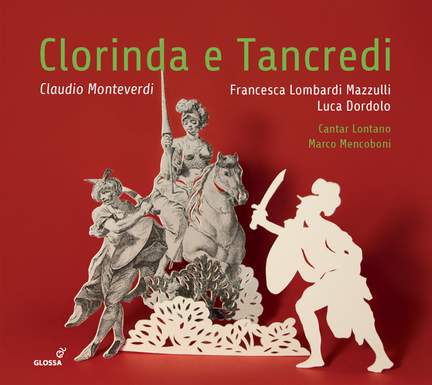
Clorinda e Tancredi
Love scenes by Claudio Monteverdi
Francesca Lombardi Mazzulli (soprano), Luca Dordolo (tenor), Riccardo Pisani (tenor), Davide Benetti (bass) & Marco Mencoboni (harpsichord, direction)
Cantar Lontano
[Dordolo’s] firm clear diction and sensitive rhetorical control, which at times moves into a kind of speech-song, extracts every last ounce of carefully calculated drama from Monteverdi’s narrow...
Clorinda e Tancredi
Love scenes by Claudio Monteverdi
Francesca Lombardi Mazzulli (soprano), Luca Dordolo (tenor), Riccardo Pisani (tenor), Davide Benetti (bass) & Marco Mencoboni (harpsichord, direction)
Cantar Lontano
Purchase product
[Dordolo’s] firm clear diction and sensitive rhetorical control, which at times moves into a kind of speech-song, extracts every last ounce of carefully calculated drama from Monteverdi’s narrow...
About
In Clorinda e Tancredi, a programme built around the vocal talents of soprano Francesca Lombardi Mazzulli and tenor Luca Dordolo, Marco Mencoboni and Cantar Lontano provide a powerful display of how, in his later secular works, Claudio Monteverdi made the music serve the word at its most intense. A sequence of madrigals – in the broadest sense of the definition of the form – is spearheaded by a dramatic interpretation of the Combattimento di Tancredi e Clorinda (with Luca Dordolo as Testo).
Francesca Lombardi Mazzulli – who also appeared on Glossa’s recent Alcina of Francesca Caccini and Silla of Handel – takes centre stage for an impassioned rendition of the Lamento della ninfa, an ostinato driven work nicely counterbalanced on this recording by a bonus track of Giovanni Felice Sances’ mesmerizing Usurpator tiranno. Two of the other pieces chosen to represent the Baroque musical “shock of the new” for this recording prepared by the Monteverdi specialist Marco Mencoboni are Ed è pur dunque vero (from the Scherzi musicali) and the Lettera amorosa (Settimo libro dei madrigali).
In his booklet essay for this new manifestation of Glossa’s abiding passion for the Seicento, Pierre Élie Mamou offers an absorbing analysis of Monteverdi’s adoption of the stile moderno, especially in terms of how it clashed with the ideals of Giovanni Maria Artusi and how it was expressed so potently in the Combattimento.
Contents and tracklist
- Francesca Lombardi Mazzulli (soprano), Luca Dordolo (tenor), Marco Mencoboni (harpsichord)
- Cantar Lontano
- Francesca Lombardi Mazzulli (soprano), Marco Mencoboni (harpsichord)
- Cantar Lontano
- Francesca Lombardi Mazzulli (soprano), Marco Mencoboni (harpsichord)
- Cantar Lontano
- Riccardo Pisani (tenor), Francesca Lombardi Mazzulli (soprano), Luca Dordolo (tenor), Marco Mencoboni (harpsichord)
- Cantar Lontano
- Francesca Lombardi Mazzulli (soprano), Marco Mencoboni (harpsichord)
- Cantar Lontano
- Davide Benetti (bass), Luca Dordolo (tenor), Riccardo Pisani (tenor), Marco Mencoboni (harpsichord), Francesca Lombardi Mazzulli (soprano)
- Cantar Lontano
- Recorded: 9-12 November 2016
- Recording Venue: Pieve Vecchia di Ginestreto, Pesaro, Italy
- Francesca Lombardi Mazzulli (soprano), Marco Mencoboni (harpsichord)
- Cantar Lontano
- Luca Dordolo (tenor), Marco Mencoboni (harpsichord)
- Cantar Lontano
- Francesca Lombardi Mazzulli (soprano), Marco Mencoboni (harpsichord)
- Cantar Lontano
- Francesca Lombardi Mazzulli (soprano), Marco Mencoboni (harpsichord)
- Cantar Lontano
Awards and reviews
 March 2018
[Dordolo’s] firm clear diction and sensitive rhetorical control, which at times moves into a kind of speech-song, extracts every last ounce of carefully calculated drama from Monteverdi’s narrow vocal range…No serious Monteverdian will want to be without it.