Voices In The Wilderness
Cello Concertos By Exiled Jewish Composers
Raphael Wallfisch (cello)
Konzerthausorchester Berlin, Nicholas Milton
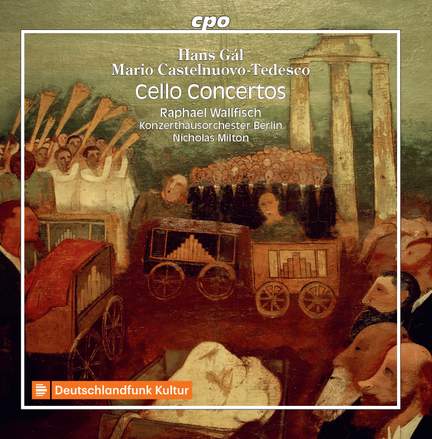
Of the two works, the Castelnuovo-Tedesco is much more virtuosic and extrovert, with lots of technically demanding passagework…In contrast, Hans Gál keeps a much tighter rein on the structural...
Voices In The Wilderness
Cello Concertos By Exiled Jewish Composers
Raphael Wallfisch (cello)
Konzerthausorchester Berlin, Nicholas Milton
Purchase product
Of the two works, the Castelnuovo-Tedesco is much more virtuosic and extrovert, with lots of technically demanding passagework…In contrast, Hans Gál keeps a much tighter rein on the structural...
About
Through a series of new recordings with CPO, cellist Raphael Wallfisch goes on a personal journey to rediscover the forgotten cello music of exiled Jewish composers who escaped Fascism and the Third Reich. The series will include premiere recordings of cello concerti by Castelnuovo-Tedesco, Weigl and Reizenstein, and Bloch’s Symphony for Cello and Orchestra. With conductor Nicholas Milton, Wallfisch has joined forces with the Berlin Konzerthaus Orchestra and Deutschland Radio. This is the first release in the series, featuring the works of Hans Gal and Castelnuovo Tedesco. Gal had a productive career as director of Mainz Conservatory. With the rise of Nazism, his career came to an abrupt end when he was dismissed from his post due to his Jewish ancestry. He eventually fled to England, and wrote his cello concerto in 1944. Italian composer Mario Castelnuovo-Tedesco migrated to the USA in 1939 following the Italian Racial Laws, which banned his music from radio and live performances. Castelnuovo-Tedesco thrived in the US, becoming a prominent film composer an dusing his Jewish heritage for inspiration. Piatigorsky premiered Castelnuovo-Tedesco’s concerto in New York in 1935, conducted by Toscanini.
Contents and tracklist
- Raphael Wallfisch (cello)
- Konzerthausorchester Berlin
- Nicholas Milton
- Recorded: 09-13 May 2016
- Recording Venue: Konzerthaus Berlin, Großer Saal, Berlin, Germany
- Raphael Wallfisch (cello)
- Konzerthausorchester Berlin
- Nicholas Milton
- Recorded: 09-13 May 2016
- Recording Venue: Konzerthaus Berlin, Großer Saal, Berlin, Germany
Awards and reviews
 March 2018
Of the two works, the Castelnuovo-Tedesco is much more virtuosic and extrovert, with lots of technically demanding passagework…In contrast, Hans Gál keeps a much tighter rein on the structural flow of ideas, and his orchestral textures are leaner…Wallfisch and the sumptuously recorded Konzerthausorchester under Nicholas Milton remain firmly persuasive advocates of both concertos.
 February 2018
Both concertos are fascinating to encounter but Gál’s is less demonstrative and more moving…The cellos sings more of longing and hope, which prepares the work’s heartening ending: whimsical then suddenly, forcefully optimistic. Gál’s cello also intertwines with an oboe to beautiful effect but Castelnuovo-Tedesco’s orchestration is more glitzy, a sonic Hollywood to Gál’s Edinburgh.