Fricker: Symphonies Nos. 1-4
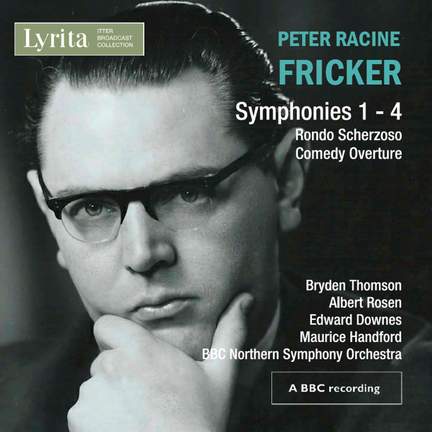
BBC Northern Symphony Orchestra, Bryden Thomson, Albert Rosen, Edward Downes, Maurice Handford
The detailed presentation is all one could desire, and Richard Itter’s domestic tapes have come up admirably. Make no mistake, there’s some intriguing and rewarding repertoire on this brave...
Fricker: Symphonies Nos. 1-4
BBC Northern Symphony Orchestra, Bryden Thomson, Albert Rosen, Edward Downes, Maurice Handford
Purchase product
The detailed presentation is all one could desire, and Richard Itter’s domestic tapes have come up admirably. Make no mistake, there’s some intriguing and rewarding repertoire on this brave...
About
‘For me music is as exciting as a sporting event. I wish that … critics and public could get as worked up about new music as they do about football and cricket’. This cri de coeur from composer Peter Racine Fricker (1920-1990) captures the passion and conviction with which he approached his craft. Fricker was born on 5 September 1920 in Ealing, London. He was educated at St. Paul’s School, London and entered the Royal College of Music in 1937. Upon demobilisation he resumed formal composition lessons with the Hungarian émigré composer Mátyás Seiber, who had lived in England since 1935. In 1952 he was appointed musical director of Morley College (succeeding Michael Tippett) and held this post for the next 12 years. During this period he was also a Professor of Composition at the RCM. Fricker was the first British composer to make his reputation entirely after World War II. Among the first composers in Britain to be influenced by the music of Béla Bartók, Arnold Schoenberg and Igor Stravinsky, Fricker assimilated aspects of their very different styles into a distinctive voice of his own. He proceeded to build an impressive body of work in his highly expressive, urbane and freely atonal language.
Contents and tracklist
- BBC Northern Symphony Orchestra
- Bryden Thomson
- BBC Northern Symphony Orchestra
- Bryden Thomson
- Recorded: 12 September 1980
- Recording Venue: BBC Studio Recording, UK
- BBC Northern Symphony Orchestra
- Albert Rosen
- Recorded: 17 September 1980
- Recording Venue: BBC Studio Recording, UK
- BBC Northern Symphony Orchestra
- Albert Rosen
- BBC Northern Symphony Orchestra
- Sir Edward Downes
- Recorded: 2 October 1980
- Recording Venue: BBC Studio Recording, UK
- BBC Northern Symphony Orchestra
- Maurice Handford
Awards and reviews
 October 2017
The detailed presentation is all one could desire, and Richard Itter’s domestic tapes have come up admirably. Make no mistake, there’s some intriguing and rewarding repertoire on this brave Lyrita anthology.
Classical Music November 2017
Born in Ealing, Fricker studied with Seiber and taught at the RCM before moving to California. His musical voice is deliciously spicy, influenced by Bartók, Schoenberg and Stravinsky. This piquancy leads to hyper-emotive slow movements (Symphonies 1 and 3), but is also felt in the more active ‘Tableau and Dance’ of the First (no missing the Bartók flavour). Maurice Handford steers the BBC orchestra impeccably. Fascinating music.