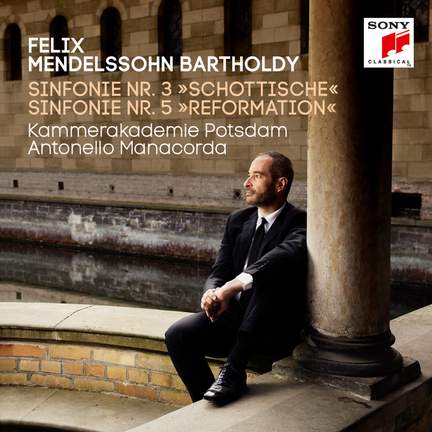
Mendelssohn: Symphonies Nos. 3 & 5
Kammerakademie Potsdam, Antonello Manacorda
Manacorda and his spruce Potsdam band (modern instruments played with historical awareness) offer a…lithe, up-tempo performance, with vivid wind detailing and clearly etched textures, not least...
Mendelssohn: Symphonies Nos. 3 & 5
Kammerakademie Potsdam, Antonello Manacorda
Purchase product
Manacorda and his spruce Potsdam band (modern instruments played with historical awareness) offer a…lithe, up-tempo performance, with vivid wind detailing and clearly etched textures, not least...
About
The Kammerakademie Potsdam, headed by Antonello Manacorda, received an Echo Klassik Award as the year's best orchestra for its complete recording of the Schubert symphonies. Now it is turning to a Mendelssohn cycle and has already received high praise for its recording of Symphonies Nos. 1 and 4: “sparkling and vivacious”, wrote the Frankfurter Allgemeine Sonntagszeitung, “a sentient being with heartbeat that breathes and never stops moving”. Now these works are followed by Symphonies Nos. 3 and 5, which occupy a special place in Mendelssohn's oeuvre. The atmospheric and popular “Scottish” Symphony (No. 3) has an autobiographical aspect in the form of the composer’s 1829 journey to Scotland, a place of longing much frequented by Central Europeans for its rugged landscapes, fog-bound seacoasts and legends of witches and sorcerers, all of which find their way into the music. Symphony No. 5, often called the “Reformation” Symphony, was written in 1830 for the 300th anniversary of the Augsburg Confession. In the event, its performance had to be postponed owing to the pan-European revolutions of 1830, and the work did not receive its première until two years later. An x8 trk piece of work.
Contents and tracklist
Awards and reviews
 August 2017
Manacorda and his spruce Potsdam band (modern instruments played with historical awareness) offer a…lithe, up-tempo performance, with vivid wind detailing and clearly etched textures, not least in the finale’s strenuous fugal bouts. Of stiffness and pomposity there is ne’er a trace…the performance of the Scottish is in similar vein, and very enjoyable it is.