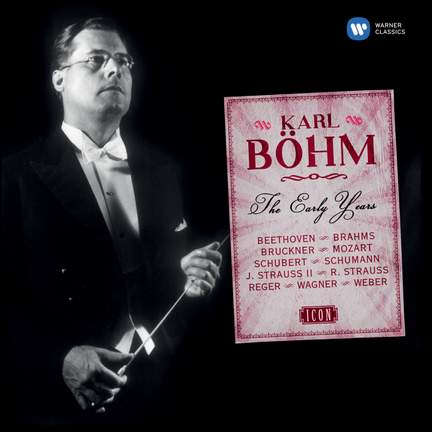
Karl Böhm - The Early Years
Jan Dahmen (violin), Max Zimolong (horn), Margarete Teschemacher (soprano), Elisabeth Höngen (alto), Torsten Ralf (tenor), Josef Herrmann (baritone), Chor der Staatsoper Dresden (chorus), Max Strub (violin), Walter Gieseking (piano), Lubka Kolessa (piano), Edwin Fischer (piano), Wilhelm Backhaus...
There are magnificent performances here, especially of Wagner (Act III of Die Meistersinger is particularly wonderful). It’s fascinating, too, to hear how different, and more characterful, the...
Karl Böhm - The Early Years
Jan Dahmen (violin), Max Zimolong (horn), Margarete Teschemacher (soprano), Elisabeth Höngen (alto), Torsten Ralf (tenor), Josef Herrmann (baritone), Chor der Staatsoper Dresden (chorus), Max Strub (violin), Walter Gieseking (piano), Lubka Kolessa (piano), Edwin Fischer (piano), Wilhelm Backhaus...
Purchase product
There are magnificent performances here, especially of Wagner (Act III of Die Meistersinger is particularly wonderful). It’s fascinating, too, to hear how different, and more characterful, the...
About
The Austrian conductor Karl Böhm is one of the towering conductors of the 20th Century. As the embodiment of the long Austro-German musical tradition, he helped to write musical history. This 19-CD set assembles all the extant recordings he conducted for EMI (notably its German Electrola label) over the period 1935 to 1949 in Dresden, Berlin, Vienna and London includes a number of rarities and the world premiere release of a version of Mozart’s Serenata notturna recorded in Vienna in 1947. It was during these years that Böhm cemented his reputation as a major conductor of Austro-German repertoire. Collectors will also be pleased to know that this set contains all the recordings that featured in the now-iconic series of Dresden-themed LP boxes released by EMI to mark Böhm’s 85th birthday in 1979.
Artists
Jan Dahmen (violin), Max Zimolong (horn), Margarete Teschemacher (soprano), Elisabeth Höngen (alto), Torsten Ralf (tenor), Josef Herrmann (baritone), Chor der Staatsoper Dresden (chorus), Max Strub (violin), Walter Gieseking (piano), Lubka Kolessa (piano), Edwin Fischer (piano), Wilhelm Backhaus (piano), Wolfgang Schneiderhan (violin), Torsten Ralf (Otello), Josef Herrmann (Iago), Torsten Ralf (Johnson), Christel Goltz (soprano), Josef Herrmann (Hans Sachs), Esther Rethy (Sophie), Elisabeth Höngen (Octavian), Margarete Teschemacher (Daphne), Torsten Ralf (Apollo), Hans Hermann Nissen (Hans Sachs), Sven Nilsson (Veit Pogner), Eugen Fuchs (Sixtus Beckmesser), Arno Schellenberg (Fritz Kothner), Torsten Ralf (Walther von Stolzing), Martin Kremer (David), Margarete Teschenmacher (Eva), Helene Jung (Magdalena), Rudolf Dittrich (Kunz Vogelgesang), Robert Büssel (Konrad Nachtigall), Klaus Hermanns (Ulrich Eisslinger), Rudolf Schmalnauer (Balthasar Zorn), Hanns Lange (Augustin Moser), Ludwig Eybisch (Hermann Ortel), Hermann Greiner (Hans Schwarz), Serge Smirnoff (Hans Foltz), Chor der Dresdener Staatsoper (chorus), Elisabeth Schwartzkopf (Liù), Set Svanholm (Siegmund), Kirsten Flagstad (Brunnhilde), Set Svanholm (Tristan), Margueritte Teschemacher (Isolde)
Sächsische Staatskapelle Dresden, Berliner Philharmoniker, Wiener Philharmoniker, Philharmonia Orchestra, Karl Böhm
Contents and tracklist
- Jan Dahmen (violin)
- Staatskapelle Dresden
- Karl Böhm
- Max Zimolong (french horn)
- Staatskapelle Dresden
- Karl Böhm
- Sächsische Staatskapelle Dresden
- Karl Böhm
- Sächsische Staatskapelle Dresden
- Karl Böhm
- Elisabeth Höngen (mezzo-soprano), Josef Herrmann (baritone), Margarete Teschemacher (soprano), Torsten Ralf (tenor)
- Sächsische Staatskapelle Dresden, Chor der Staatsoper Dresden
- Karl Böhm
- Max Strub (violin)
- Staatskapelle Dresden
- Karl Böhm
- Lubka Kolessa (piano)
- Staatskapelle Dresden
- Karl Böhm
- Sächsische Staatskapelle Dresden
- Karl Böhm
Awards and reviews
 8th December 2017
There are magnificent performances here, especially of Wagner (Act III of Die Meistersinger is particularly wonderful). It’s fascinating, too, to hear how different, and more characterful, the Vienna Philharmonic sounded in the 1930s and 1940s.