Special offer. Armida Quartett: Fuga Magna
Armida Quartett
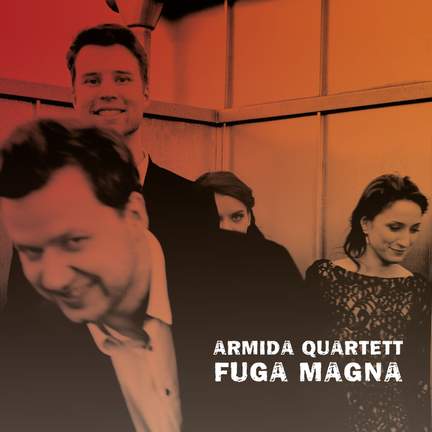
The Armidas aren’t shy of sanding off some of their polish when occasion deserves. Instead what we have here is a warm, loving and perceptive advocacy of the fugue…It’s wonderful stuff. Truly...
Special offer. Armida Quartett: Fuga Magna
Armida Quartett
Purchase product
The Armidas aren’t shy of sanding off some of their polish when occasion deserves. Instead what we have here is a warm, loving and perceptive advocacy of the fugue…It’s wonderful stuff. Truly...
About
The act of thinking and composing in counterpoint – in fugues – has reigned as the supreme musical discipline ever since Western music emerged around the year 1200 from the shadows of purely oral transmission to be codified in writing, initially in mensural notation.
Our seven-league-boot journey across the realm of fugue begins with the two earliest published German works in the genre for instrumental ensemble from the year 1602. The first of them has ethereal motifs which it rather cautiously explores, whereas the second is based on the folk song O Nachbar
Roland, mein Herz ist voller Pein (which Samuel Scheidt arranged as a magnificent canzone for strings in 1621). Haussmann’s Fugae are written “for all kinds of instruments”: idiomatic passagework for violin is thus entirely absent here, and only emerged as a stylistic trait in the course of the 17th century.
Alessandro Scarlatti is the composer of four sonatas that are to be performed senza cembalo, as he specifies, and which are often referred to as the first string quartets. The animated movements are complex counterpoint constructions; the middle movements are tortuous harmonic meanders brimming with ligature et durezze; the final movements are all short, ironic minuets with the two violin parts in unison.
Contents and tracklist
- Armida Quartett
- Recorded: 2017
- Armida Quartett
- Recorded: 2017
- Armida Quartett
- Recorded: 2017
- Armida Quartett
- Recorded: 2017
- Armida Quartett
- Recorded: 2017
- Armida Quartett
- Recorded: 2017
- Armida Quartett
- Recorded: 2017
- Armida Quartett
- Recorded: 2017
- Armida Quartett
- Recorded: 2017
- Armida Quartett
- Recorded: 2017
Spotlight on this release
-
An error occurred.
Try watching this video on www.youtube.com, or enable JavaScript if it is disabled in your browser.
Awards and reviews
 October 2017
The Armidas aren’t shy of sanding off some of their polish when occasion deserves. Instead what we have here is a warm, loving and perceptive advocacy of the fugue…It’s wonderful stuff. Truly one to both savour and admire.