Dvorak & Suk: Piano Quartets
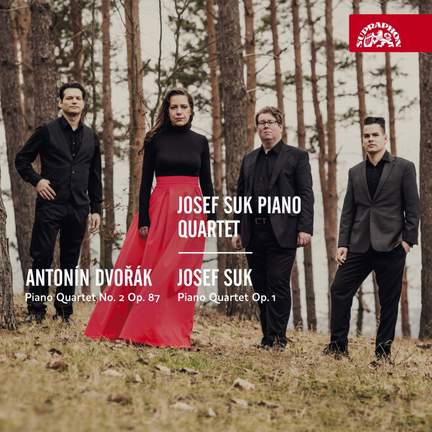
Josef Suk Piano Quartet
Awards:
-
Record Review, 26th August 2017, Recording of the Week

There are times when their tempos seem a little wayward, notably at the end of the first movement, but these interpretative nuances never get in the way of the expressive intentions of the piece,...
Dvorak & Suk: Piano Quartets
Josef Suk Piano Quartet
Purchase product
Awards:
-
Record Review, 26th August 2017, Recording of the Week
There are times when their tempos seem a little wayward, notably at the end of the first movement, but these interpretative nuances never get in the way of the expressive intentions of the piece,...
About
The mature Antonín Dvořák vs. the teenage Josef Suk – a duel with two victors.
Recorded at the Concert Hall of the Prague Conservatrory 2016.
Works by Antonín Dvořák and Josef Suk – a teacher and his devoted pupil, the father-in-law and his son-inlaw – have customarily been performed together at concerts and featured next to each other on recordings. Yet that is all they have in common.
Dvořák’s Opus 87 reveals the personal and creative maturity of the 48-year-old composer, who at the time was in the prime of his life. Soon after completing his quartet, the maestro assumed the post of professor of composition at the Prague Conservatory. This decision would prove to be fateful – yet not so much for himself as it would be for the 17-year-old Suk, who was one of the most gifted students of Dvořák’s selected class. A child prodigy, Suk had enrolled at the conservatory at the age of 16, and a few years later he would be travelling around the world as a member of the famed Czech Quartet. He gave his Piano Quartet, which he wrote under Dvořák’s guidance, the symbolical opus number 1. The piece reflects his contemporary auto-stylisation as a passionate, flaring youth, yet its melodic forcibility and tenderness match that of Dvořák’s work.
The Josef Suk Piano Quartet (formerly the Ensemble Taras) has manifested its extraordinary qualities at international competitions (victory at the Concorso Salieri-Zinetti in Verona, the ACM Premio Trio di Trieste), as well as on concert stages all over the world.
The recording makes it evident that the young musicians have Dvořák and Suk in their blood.
Contents and tracklist
Awards and reviews
-
Record Review26th August 2017Recording of the Week
 January 2018
There are times when their tempos seem a little wayward, notably at the end of the first movement, but these interpretative nuances never get in the way of the expressive intentions of the piece, and the playing throughout is unfailingly beautiful. Altogether, these are passionate and convincing performances.
 Awards Issue 2017
All four musicians are steeped in the Czech tradition, which in terms of the string players means warmth and an unfettered ease that is very engaging. Climaxes are full-throated but never overstated…[the Suk is] given the best possible advocacy by these players…right down to the slightly over-the-top closing bars.
 20th July 2017
they play with huge sound, loving detail and the kind of conviction and authority that comes from personal connection.