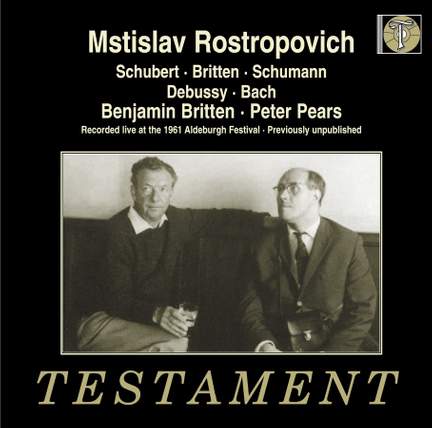
Rostropovich & Britten
Recorded live at the 1961 Aldeburgh Music Festival - Previously unpublished
Mstislav Rostropovich (cello) & Benjamin Britten (piano), Peter Pears (tenor)
Awards:
-
Presto Recording of the Week, 14th April 2017

-
Presto Recordings of the Year, Finalist 2017

this Testament release of Rostropovich in his debut at the Aldeburgh Festival catches the cellist somewhere near his early and all-conquering best
Rostropovich & Britten
Recorded live at the 1961 Aldeburgh Music Festival - Previously unpublished
Mstislav Rostropovich (cello) & Benjamin Britten (piano), Peter Pears (tenor)
Purchase product
Awards:
-
Presto Recording of the Week, 14th April 2017
-
Presto Recordings of the Year, Finalist 2017
this Testament release of Rostropovich in his debut at the Aldeburgh Festival catches the cellist somewhere near his early and all-conquering best
About
This recital at the Jubilee Hall on 7 July 1961 began with Schubert’s ‘Arpeggione’ Sonata, which Rostropovich had learnt at Britten’s behest. Anyone who knows the studio version which the duo made for Decca in 1968 will find this performance a revelation.
In the case of Britten’s Cello Sonata, the famous Decca recording was made a mere two weeks later and resulted in a definitive performance. Nevertheless, hearing how these two great musicians approached the work in its first performance is of much more than academic interest. The Dialogo starts and ends in elfin mood and is full of fantasy. The sense of fantasy also inhabits the Scherzo-Pizzicato, where Britten adds superb filigree playing to Rostropovich’s pizzicati: the magical effect brings us close to the fairies of A Midsummer Night’s Dream, premièred at Aldeburgh the previous year [and now available on Testament SBT2 1515]. The Elegia is the heart of the Sonata, distilling some half-remembered sadness with lovely tone from Rostropovich and great intensity from both players. The Marcia is like a manic dance-scherzo, with both artists calling on their reserves of colour and the concluding Moto perpetuo – which incorporates Shostakovich’s DSCH motif – is like a fantastic chase. The next two works were also successfully recorded for Decca, at the same sessions as the Britten Sonata. In the concert Schumann’s Five Pieces in Folk Style are played with great character and the duo get right inside Debussy’s Sonata: in both works Britten rises to the challenge of matching Rostropovich’s intense virtuosity, so that the outcome is exhilarating. At the end of the recital they encore the Marcia of the Britten, making it even more bizarre than before and then there is the sort of surprise ending that Rostropovich loved. On the previous night Peter Pears joins the two instrumentalists for a beautiful performance of the tenor aria with cello obbligato, ‘Woferne du den edlen Frieden’, from Bach’s Cantata BWV.41. His appearance emphasises the family nature of the Aldeburgh Festival in those days, and indicates that the Rostropoviches have already been admitted to the magic circle.
As a substantial further bonus, we have one of the two Bach Suites that Rostropovich played in the Parish Church three days earlier – the other seems not to have survived. The cellist did not make a studio recording of the complete Suites until very late in his career, when aspects of his interpretations, especially the Minuets,Bourrées and Gavottes, had become rather heavy. Tully Potter 2017
Contents and tracklist
Spotlight on this release
-
Previously unreleased cello recital by Mstislav Rostropovich and Benjamin Britten
14th Apr 2017
James enjoys a newly-released gem from Testament's archives, featuring Britten accompanying the legendary Rostropovich at the piano.

Awards and reviews
-
Presto Recording of the Week14th April 2017
-
Presto Recordings of the YearFinalist 2017
 July 2017
this Testament release of Rostropovich in his debut at the Aldeburgh Festival catches the cellist somewhere near his early and all-conquering best
 14th April 2017
If I had to sum up this recital in a single word, it would be freedom. Every phrase is elegantly elastic, and there's some pleasingly delicate playing by Britten, especially in the final Schumann piece. The range of attack and articulation on offer from Rostropovich is quite extraordinary.
 3rd May 2017
there’s a special sense of occasion in each bar of these performances...The [Arpeggione] has real spontaneity, with Rostropovich bringing a wonderful range of touch and colour to Schubert’s melodies, Britten the perfect, tactful partner...The mono recordings may not be state of the art, even for 1961, but they’re good enough to convey what memorable events these concerts must have been.
Classical Music July 2017
This is the world premiere of Britten’s sonata, a tense, compact work written expressly for Rostropovich and fitting him like a glove; and the sheer magnetism of both musicians’ playing is jaw-dropping. The Schubert is warm and expressive...the Debussy and Schumann are vivid and captivating…with generous Bach bonuses and naturally-balanced mono sound, this is a hugely important release