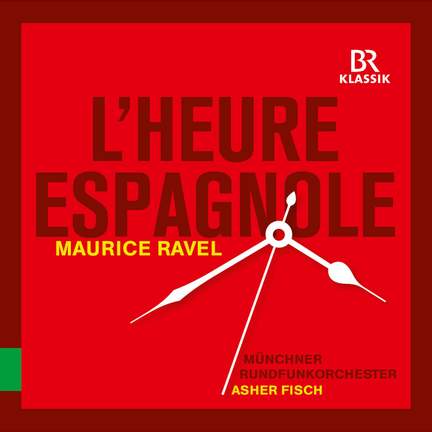
Ravel: L’heure espagnole
Live recording from a recent Munich "Sonntagskonzert" on April 24, 2016, Prinzregententheater, Munich
Gaëlle Arquez (Concepcion), Julien Behr (Gonzalve), Mathias Vidal (Torquemada), Alexandre Duhamel (Ramiro) & Lionel Lhote (Don Inigo Gomez)
Münchner Rundfunkorchester, Asher Fisch
Fisch aims for headiness but avoids blatancy. Rhythms pulse and throb, and the Hispanic turns of melody often have a pointed suavity that hints at innuendo...The singers play it straight without...
Ravel: L’heure espagnole
Live recording from a recent Munich "Sonntagskonzert" on April 24, 2016, Prinzregententheater, Munich
Gaëlle Arquez (Concepcion), Julien Behr (Gonzalve), Mathias Vidal (Torquemada), Alexandre Duhamel (Ramiro) & Lionel Lhote (Don Inigo Gomez)
Münchner Rundfunkorchester, Asher Fisch
Purchase product
Fisch aims for headiness but avoids blatancy. Rhythms pulse and throb, and the Hispanic turns of melody often have a pointed suavity that hints at innuendo...The singers play it straight without...
About
The thought of Spain filled many French composers of the 19th and early 20th century with musical yearning – one has only to think of Georges Bizet's opera "Carmen", Maurice Ravel's "Rhapsodie espagnole" (1907), or his famous "Boléro" (1928). Ravel was already inspired by things Iberian in his first work for the stage: "L’heure espagnole" ("The Spanish Hour"), a one-act musical comedy set in Toledo, which premiered in Paris on May 19, 1911. Here he combined fantasy and comedy in the action with “spoken music” full of local Spanish colour. The short opera ends, for instance, with a fiery habanera. Ravel masterfully and wittily integrates the clocks chiming in the workshop of clockmaker Torquemada into the score, together with the sound of their ticking, and of all kinds of chimes or mechanical music machines producing cuckoo calls when striking the hour. Emmanuel Chabrier's rhapsody for orchestra with the promising title of "España" was composed in 1883 and premiered in Paris. The music was inspired by a Spanish journey that Chabrier had undertaken the year before, during which he had noted down many original motifs and rhythms. Spanish folklore is ever-present; in addition to the melodies, it is above all the rhythmic motifs and movement patterns that, when combined, achieve a complexity that was still unknown in art music at that time. A magnificently rousing dance piece in rapid triple time.
A concert performance of the two works took place on April 24, 2016 as part of the "Sonntagskonzerte" (Sunday Concerts) series in Munich’s Prinzregententheater, and can now be experienced on CD. Ravel's opera (in its original French-language version) is interpreted by young soloists, all of them entirely at home in the Franco-Spanish oeuvre; they are accompanied by the Munich Rundfunkorchester under the direction of Asher Fisch.
Contents and tracklist
- Alexandre Duhamel, Mathias Vidal, Gaëlle Arquez, Julien Behr, Lionel Lhote
- Munich Radio Orchestra
- Asher Fisch
Awards and reviews
 July 2017
Fisch aims for headiness but avoids blatancy. Rhythms pulse and throb, and the Hispanic turns of melody often have a pointed suavity that hints at innuendo...The singers play it straight without resorting to caricature. The results are often nicely ambivalent...Arquez's glamorous Concepción has a wonderful line in understated obscenity...It's a fine achievement.
 June 2017
No reason to hesitate with this impressive live recording.
classicalsource.com September 2017
Asher Fisch conducts the Munich Radio Orchestra with excellent control and sensitivity; the cast of five singers is well suited to the task. A glittering concert performance of Chabrier’s España, added as an extra offering on the disc, reminds us of the composer who was one of Ravel’s major influences.