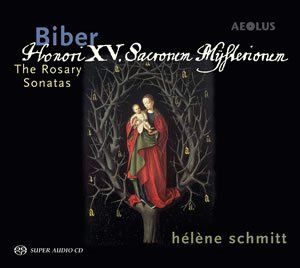
Biber: The Rosary Sonatas
Helene Schmitt (violin – by Camillo Camilli early 18th century)
Schmitt’s reflections on performing the cycle are evocative and informative…that said, the tempi chosen throughout are far slower than the norm…all of this certainly presents the cycle in a...
Biber: The Rosary Sonatas
Helene Schmitt (violin – by Camillo Camilli early 18th century)
Purchase product
Schmitt’s reflections on performing the cycle are evocative and informative…that said, the tempi chosen throughout are far slower than the norm…all of this certainly presents the cycle in a...
About
The Rosary Sonatas not only deal with mysteries, they are a mystery themselves. With this violin cycle made up of fifteen sonatas and a solo passacaglia, Biber created one of the most astonishing works of the entire violin repertoire. Famous and even today not completely decrypted in terms of its significance, is the assignment of the sonatas to the sacred Christian mysteries. In this work, the composer carries to the extreme the scordatura technique, the tuning of the violin’s four strings to intervals other than the usual, and in this manner demands constant concentration from the performer. For the French violinist Hélène Schmitt, the Rosary Sonatas are nevertheless not merely a violinistic extreme sport – on the contrary, for her this work is a musical act of faith. In her performance, an enormous sonic cosmos opens up in the sonatas: singing or also speaking, whispering, even roaring, urgent or dulcet, intimate or with large gestures, from hardly audible sound to pure heavy metal, or entirely simple in duple time for the many dance movements – the listener will not ceased to be astonished.
Contents and tracklist
- Helene Schmitt (violin – by Camillo Camilli early 18th century)
Awards and reviews
 November 2016
Schmitt’s reflections on performing the cycle are evocative and informative…that said, the tempi chosen throughout are far slower than the norm…all of this certainly presents the cycle in a differently light