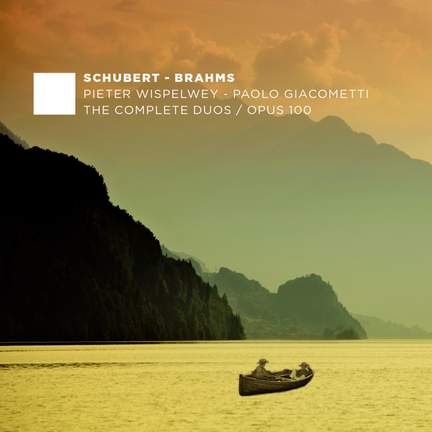
Schubert & Brahms: The Complete Duos: Opus 100
Pieter Wispelwey (cello) & Paulo Giacometti (piano)
Wispelwey and Paolo Giacometti offer appropriately imperious performances of the first three moments and they’re admirably light in the affable finale…these are fine performances, and if you’re...
Schubert & Brahms: The Complete Duos: Opus 100
Pieter Wispelwey (cello) & Paulo Giacometti (piano)
Purchase product
Wispelwey and Paolo Giacometti offer appropriately imperious performances of the first three moments and they’re admirably light in the affable finale…these are fine performances, and if you’re...
About
The summer of 1886 was one of the most prolific in the life of Johannes Brahms. The alpine grandeur of Lake Thun and Brahms’s buoyant holiday mood conjured up so many melodies that he declared he was “afraid to step on them”. In a few weeks’ time, Brahms produced two of his major chamber works, the Cello Sonata, op.99, and the Violin Sonata, op.100, that suits the cello delightfully. These chamber icons are aptly coupled to Schubert’s blissfully uplifting Sonata, D574. Cello virtuoso Pieter Wispelwey is at once playful and profound in these summer works, and his interpretation is, from now on, open to debate in The Interpretation Room.
Pieter Wispelwey and Paulo Giacometti will record the complete chamber duos by Franz Schubert and Johannes Brahms on 6 CDs.
Wispelwey and Giacometti have been called “exceptionally imaginative and impassioned performers” (American Record Guide), and their collaboration has spawned recordings rated as “fascinating, provocative, almost perverse” on account of their “immediacy and involvement” (Sunday Times).
Contents and tracklist
Spotlight on this release
-
An error occurred.
Try watching this video on www.youtube.com, or enable JavaScript if it is disabled in your browser.
Awards and reviews
 April 2017
Wispelwey and Paolo Giacometti offer appropriately imperious performances of the first three moments and they’re admirably light in the affable finale…these are fine performances, and if you’re attracted by the notion of the transcribed pieces you couldn’t do better