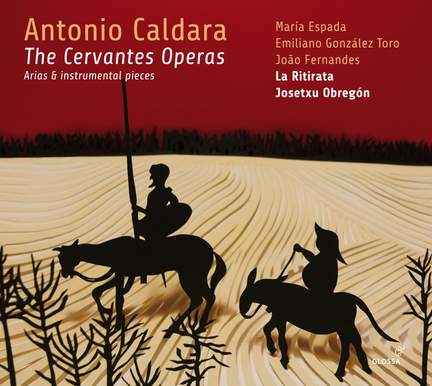
Caldara: The Cervantes Operas
Arias & instrumental pieces
María Espada (soprano), Emiliano González Toro (tenor) & João Fernandes (bass)
La Ritirata, Josetxu Obregón (artistic direction)
Whether or not one likes the artistic licence of post-historically informed capriciousness, these spirited performances afford a glimpse of how a literary genius of one epoch had a direct influence...
Caldara: The Cervantes Operas
Arias & instrumental pieces
María Espada (soprano), Emiliano González Toro (tenor) & João Fernandes (bass)
La Ritirata, Josetxu Obregón (artistic direction)
Purchase product
Whether or not one likes the artistic licence of post-historically informed capriciousness, these spirited performances afford a glimpse of how a literary genius of one epoch had a direct influence...
About
Arias from the operas Don Chisciotte in Corte della duchessa (Vienna, 1727) and Sancio Panza Governatore dell’isola Barattaria (Vienna, 1733) with instrumental interludes included in the original operas, composed by Nicola Matteis (c.1650-c.1714).
In commemoration of the 400th anniversary of the death of Miguel de Cervantes, La Ritirata and Josetxu Obregón have created a programme for Glossa sallying forth on the back of music composed by Antonio Caldara and inspired by 'El ingenioso hidalgo Don Quijote de la Mancha'.
Antonio Caldara was neither the first nor the last composer to have his compositional ingenuity sparked off by Cervantes’ timeless masterpiece. He may well have been propelled forwards by his own experiencing the Spanish soundscape within a century of the publication of the two parts of the Don Quijote: Barcelona was a working 'port of call' for Caldara after Mantua and Rome and before Vienna. For the Viennese court he wrote a pair of operas (with librettos by GC Pasquini): 'Don Chisciotte in Corte della Duchessa' and 'Sancio Panza Governatore dell’isola Barattaria', and from these works Obregón – like Caldara also a cellist – has put together a selection of arias.
Soloists María Espada, Emiliano González Toro and João Fernandes invest their abundant collective artistry in bringing to life a rapid series of Cervantine characters, not least the Spanish knight and his squire. Interspersed between these vocal contributions are a series of instrumental ballets composed for these operas by Nicola Matteis, who also worked at the Viennese court. In the booklet essay Begoña Lolo and Adela Presas set the scene for Caldara’s contribution to the musical legacy of Don Quixote.
Contents and tracklist
- La Ritirata
- Josetxu Obregón
- João Fernandes (bass)
- La Ritirata
- Josetxu Obregón
- María Espada (soprano), Ignacio Prego (harpsichord)
- Recorded: May 2016
- Recording Venue: Universidad Autónoma de Madrid, Spain
- Emiliano Gonzalez Toro (tenor), João Fernandes (bass)
- La Ritirata
- Josetxu Obregón
- Recorded: 2016
- Recording Venue: Universidad Autonóma
- María Espada (soprano), Ignacio Prego (harpsichord)
- La Ritirata
- Josetxu Obregón
- Recorded: May 2016
- Recording Venue: Universidad Autónoma de Madrid, Spain
- La Ritirata
- Josetxu Obregón
- Recorded: May 2016
- Recording Venue: Universidad Autónoma de Madrid, Spain
Awards and reviews
 December 2016
Whether or not one likes the artistic licence of post-historically informed capriciousness, these spirited performances afford a glimpse of how a literary genius of one epoch had a direct influence on operatic culture in a different country over a century later
 January 2017
Toro…is highly effective … this is a CD that should be of considerable interest for anyone interested in Cervantes and/or the music of Caldara, of which we still know relatively little.